


The market is flooded with offers. 3D game development companies are growing faster than the projects themselves manage to launch.
Every other website promises “production-ready assets” and “AAA quality” – yet offers neither metrics nor actual case studies. You spend a week on correspondence, another two weeks on the first draft, and then you receive something that doesn’t fit into any pipeline.
The problem is not that good contractors do not exist. The problem is that without a clear evaluation system, you are choosing blindly.
And the price of a mistake is not just money: it is a blown milestone, a delayed release, and a team that has to redo someone else’s work.
This material is not a “top 10 studios” review. Here, you will find concrete criteria to evaluate a contractor in the field of 2D and 3D game development services, along with red flags you need to spot before signing a contract.

Why Studios Outsource Game Development
Access to Expertise Missing Internally
Finding a single person who works equally well with 3D game modeling development services, configures rigging, writes shaders, and understands draw calls for a mobile engine is nearly impossible.
Good outsourcing studios maintain specialized teams: separate technical artists, separate concept art, and separate animation. Each specialist focuses on their own domain. Ultimately, this makes a noticeable difference in quality.
Economics: What is Really Cheaper
An in-house 3D generalist in the US or Western Europe costs $80–120/hour.
An outsource 3D game development company with a streamlined pipeline costs $35–65/hour for an equivalent volume, with predictable iteration times. On a project with 200+ assets, the difference turns into hundreds of thousands of dollars in savings on payroll alone.
Scalability for Peak Loads
Before a release, the volume of tasks always expands. Keeping a team at peak capacity all year round is inefficient.
Outsourcing allows you to scale performance for a specific phase: one team configuration is needed in pre-production game development services, while a completely different one is required for full-scale production. VSQUAD integrates new specialists into a client’s pipeline within 48 hours.
A Fresh Look at Visual Solutions
An internal team gets “tunnel vision.” After three months of working on a single project, artists stop seeing the obvious: unreadable character silhouettes, inconsistent texel density, and messy LOD transitions.
An external team spots these issues immediately – and voices them openly.
Mitigating the Risk of Technical Debt
An error in character retopology discovered during the animation stage costs 3–4 times more than the same error found during the blockout stage.
Studios with an established QA process catch such problems before they ever make it into production.
Struggling to scale your internal art team for an upcoming production phase?
Get access to specialized 2D/3D artists and technical directors who integrate seamlessly into your pipeline within 48 hours, keeping your milestone schedule and budget completely predictable.
How the Pipeline Breaks Without the Right Partner - and How It Should Work
Most failures do not start with bad art. They start with choosing the wrong partner.
Scenario One: Freelancers Instead of a Team. One good artist handles the concept. Then they go on vacation for two weeks at the worst possible moment. Or it turns out they do not know how to create LODs for mobile, and the asset lacks the proper topology for rigging.
Result: three weeks are lost, and the work is redone by another person who did not understand the initial context. Relying on independent 3D game developers without agency support often introduces these structural vulnerabilities.
Scenario Two: A Studio Without a Technical Review. The concept is beautiful. The model is beautiful. But not a single asset has passed a check for draw calls. The engine begins to lag exactly on the level that was supposed to be the main feature of the demo.
This is not a hypothetical scenario – it is a standard story for projects where there is no structured process between the art team and the technical artist.
The Unreal Engine documentation explicitly states that draw calls are commands sent to the GPU to render assets on every frame, and their number critically depends on the count of unique meshes and material IDs: Guidelines for Optimizing Rendering for Real-Time. If an artist does not know this at the modeling stage, all optimization falls on the shoulders of your technical artist, and those are reworks at your expense.
Scenario Three: No Milestone Structure. The contractor accepted the brief, vanished for a month, and sent the “final.” The final does not match the art references, fails to comply with the technical specifications, and now you have two choices – accept it or spend another three weeks on iterations for an additional budget.
How it should work: a contractor that has an Art Director + Concept Artist + Tech Artist in a single pipeline catches all three scenarios before they become a problem.
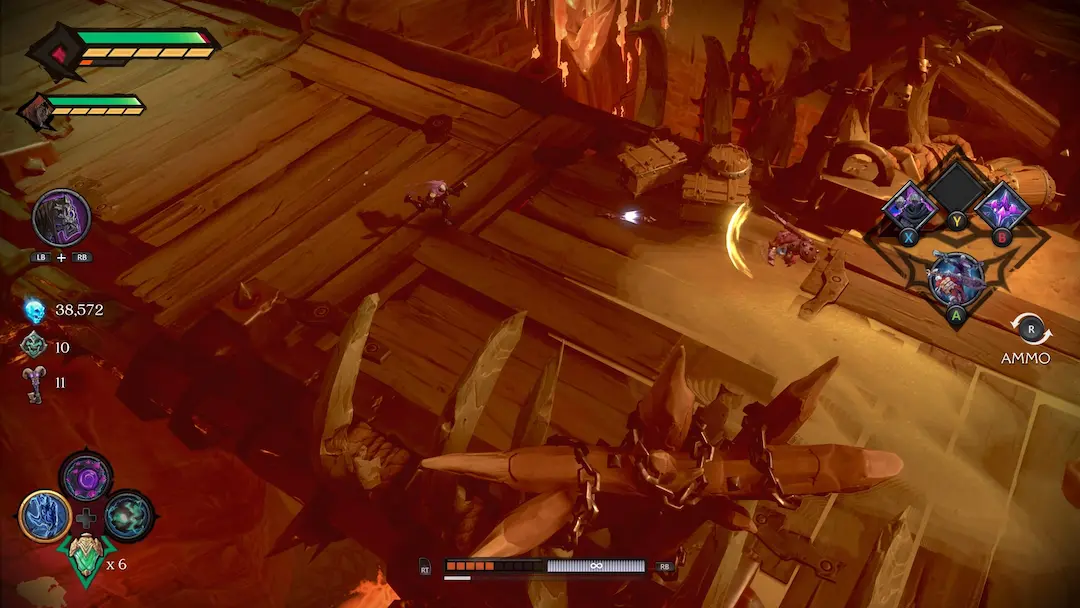
On the Wayfinder project for Airship Syndicate, VSQUAD delivered over 200 assets – characters, creatures, weapons, industrial vehicles – with each asset passing an art director review before being sent to the client. This is exactly what made it possible to maintain stylistic consistency across a massive volume of work.
According to industry analysts, the market for game development services & solutions grew to $4.2 billion in 2024 and continues to expand at 14% annually. This is a direct consequence of studios moving away from viewing outsourcing as a “backup plan” and instead embedding it into their core production strategy. Outsourcing covers the deficit of narrow expertise systematically, rather than sporadically.
What Exactly Can Be Delegated to a Partner
Below are the tasks that make sense to hand off externally, and those that are better kept internal.
To outsource:
– 3D modeling of characters, creatures, and NPCs (sculpt → retopo → UV → textures)
– Props, weapons, and vehicles – anything requiring a strict technical standard
– Environment and modular assets for a specific engine (Unreal / Unity / Godot)
– 2D concept art and character sheets for subsequent transition into 3D
– Animation (idle, combat, locomotion) given a ready-made rig
– VFX effects based on approved reference lists
– Prototyping and prototype game development services at early stages
– Technical tasks: LOD optimization, normal map baking, and PBR textures setup
To keep internal:
– Art direction and approval of the visual style
– Key game design and development services – core loop, gameplay mechanics
– Narrative and story iterations
– Milestone monitoring and final acceptance
A clear separation of these zones is the very first thing you need to establish before going to market for a contractor.

The Process of Working with an Outsource Studio: 6 Steps
A good contractor does not work under a “take the brief – wait for the result” scheme. A professional process is structured from day one: every stage has specific deliverables, deadlines, and control points. Here is how this process looks in practice.
1. Define the Scope and Technical Constraints
Before any negotiations, formulate on your end: the target platform, the asset budget, key deadlines, and technical requirements – poly-count, texture format, and whether a rig is needed. Studios that begin work without these data points will end up with reworks.
A real-world example: a project where the poly-budget was not fixed at the start received a hero model with 85,000 polygons instead of the allowed 25,000 – and spent an additional three weeks on retopology.
2. Research Potential Partners
Filter candidates by domain expertise, not just a beautiful website. You need a contractor with experience specifically in your genre and technical stack: a mobile RPG developer and a studio specializing in AAA PC shooters operate in different niches with completely different pipelines.
Look at actual shipped projects. If a company has worked on Wayfinder or Battle Chasers, that is a concrete signal of their capabilities, not just a line in a portfolio.
3. Review Portfolios and Technical Quality
A beautiful render in Marmoset is not the same thing as a production-ready asset. Request wireframes, UV layouts, poly counts, and – if possible – an imported asset inside the engine. Check whether the texel density meets accepted standards and if there are topology issues that will break the rigging.
The official Epic tutorial serves as an excellent benchmark for poly-budgets and LOD configurations: Polycount, Optimization and Draw Calls. If a studio cannot or does not want to show technical files, it is a major red flag.
4. Align on the Technical Specifications and Milestone Structure
This is where most outsourcing collaborations fall apart. The absence of a clear technical specification leads to every iteration becoming an argument over what “was meant.” Consequently, the budget drains into endless fixes.
A proper alignment includes: an approved style guide, a list of deliverables for each milestone, the number of included revisions, and the format of handoff files (FBX/OBJ/MA with texture maps in the required resolution). VSQUAD fixes the milestone structure in the contract before work starts – iterations are written out in advance, leaving no surprises for the budget.
5. Monitor Progress via Checkpoints
Weekly check-ins are not bureaucracy; they are your risk management tool. A good contractor will independently initiate intermediate reviews at 30%, 60%, and 90% asset readiness. This allows you to catch deviations from the style guide before finalization rather than after.
The VSQUAD team integrates into the client’s tools – Perforce, Jira, Slack – and manages task statuses directly there, without relying on parallel messaging apps.
6. Final Review and Iteration Cycle
Final acceptance is not a formality. It is a cross-examination of each asset against the initial goals: style guide compliance, technical requirements, and performance in the engine.
If something fails to pass, a professional studio already has an iteration protocol mapped out: not a vague “we will redo everything,” but a specific list of corrections with a clear deadline. On the indie projects VSQUAD handles, this approach allows us to close revisions within 3–5 business days, without dragging iterations out for weeks.
Ready to eliminate technical debt and secure your project’s launch date?
Share your current asset requirements and technical constraints with our team to receive a tailored production strategy and a precise milestone breakdown.
Novices vs. VSQUAD: Where the Budget is Lost
| Criterion | Novice / Casual Contractor | VSQUAD Studio |
|---|---|---|
| Technical Review | After delivery, if it happens at all | Built into the pipeline at every single stage |
| Communication | Disjointed chats, unpredictable response times | Direct work inside the client's Jira / Perforce / Slack |
| Style Consistency | Depends entirely on a single artist | Art Director reviews every single asset |
| Scalability | One freelancer = a hard ceiling on productivity | The team scales dynamically based on task volume |
| Milestone Structure | Done when it's done | Deadlines are locked in the contract before launch |
| Shipped Project Experience | Portfolio consisting of student/tutorial work | Wayfinder, Darksiders Genesis, Battle Chasers, SMITE |
| Engine Orientation | Looks good in the render | Production-ready: PBR textures, LODs, correct baking |
The gap in performance is not felt on the very first asset – it compounds over time. By milestone No. 3, an unpredictable contractor has already cost you 2–3 additional revisions per asset, and that is just the beginning of your technical debt.

Fun Fact
Did you know that the term “3D game development” as a distinct industry job category only began appearing in mass job descriptions in 1997 – shortly after Quake and Tomb Raider had already driven 3D gaming into the mainstream? The market always catches up to technology with a slight delay.
About Us
VSQUAD Studio is an art outsourcing studio and a 2D and 3D game development company founded in 2015. We provide comprehensive 2D and 3D game development services: characters, environments, props, animation, VFX, and a full development cycle on Unity, Unreal Engine, and Godot. Over 10 years of operation, we have completed 50+ projects across various platforms and genres.
We do not just deliver assets. We embed ourselves into the client’s pipeline and take full responsibility for the final outcome. Within 48 hours, we deploy a full team featuring an Art Director, concept artists, and technical specialists – tailored to your tasks, your engine, and your deadlines.
Our track record includes projects like Wayfinder (Airship Syndicate), Darksiders Genesis, Battle Chasers, Ruined King, and SMITE. We partner with indie teams and AAA studios alike – a portfolio dedicated to indie projects is available separately.
Our game co-development services cover the entire cycle: from initial prototypes to production-ready assets built for your specific engine.
FAQ
The cost depends on volume and complexity. A single production-ready 3D character (sculpt → retopo → textures → LOD) ranges from $600 to $2,500. A complete asset kit for a mobile RPG with 20–30 characters and environments starts from $25,000 and up.
The exact figure is formed after a scope session where the poly-budget, engine format, and number of revisions are locked in. We do not take upfront payments without an agreed technical specification – this is a fair stance for both sides.
Estimated price ranges:
– Prop / weapon production-ready: $200–800
– 3D character with PBR textures and LOD: $600–2500
– Modular environment kit (20 elements): $3000–8000
VSQUAD does not establish parallel management systems – we step directly into yours. Within the first 48 hours, our team receives access to your repository, tasks appear on your Jira board, and statuses are updated right there.
There is no parallel correspondence in messaging apps where context can easily get lost. If you operate via Notion, Trello, or Slack, we adapt to them seamlessly. Our goal is for our team to feel like an organic extension of yours, rather than an external contractor that requires separate onboarding for every single detail.
The number of included revisions is locked in the contract before we start – typically 2–3 rounds per asset within the scope of the agreed technical specification. Amendments beyond the initial brief are evaluated separately and approved in writing.
In practice, most significant misalignments are neutralized during the Align phase (Step 4 of our process), when the style guide and deliverables are finalized prior to launching production – not after.
The milestone structure along with deadlines is clearly written into the contract. Every milestone features a specific delivery date and an explicit checklist of deliverables.
If we miss a milestone due to our own fault, the next block of tasks is executed with absolute priority at no additional expense to you. Transparency regarding timelines is one of our studio’s foundational principles.
Yes. Our client list includes teams with art budgets starting at $5,000 – these primarily involve prototype game development services or targeted outsourcing of a specific asset type (for example, just weapons or just environments for a single zone).
For indie creators, predictability of costs is vital, which is why we always guarantee a price ceiling before launching and never present surprise invoices. Learn more about working with indie studios in our portfolio.
The intellectual property rights for all delivered assets completely transfer to you upon final payment. Until that moment, VSQUAD retains the right to display the work in our portfolio (unless specified otherwise – custom NDA setups are discussed separately).
The final handoff encompasses source files (Maya, ZBrush, Substance) alongside game-ready formats optimized for your engine. There are zero licensing restrictions on commercial utilization.
Ready to Scale Your Production?
Choosing a 3D game development contractor is not primarily a matter of budget. It is a matter of system. A studio forging ahead without an art director in their pipeline, operating without a milestone structure, and omitting technical reviews is a compounding source of technical debt that you will be paying off for months after your project closes.
Outsourcing equals the mitigation of production risks and absolute predictability of your budget at every single milestone.
VSQUAD is the partner that delivers exactly this through the synchronous performance of an Art Director + Tech Artist + a dedicated team of artists, integrated directly into your pipeline from day one.
Ready to discuss your project? Contact us → 📩 head@vsquad.art or schedule a call.
Our Game Services
Get in touch
Got a project in mind? We usually reply within a day.