


Most teams making a game for the first time enter production with one number in mind and leave with a completely different one. Sometimes it is 50% more. Sometimes, it is three times more.
This is neither a catastrophe nor a force majeure. This is a systemic feature of the first project: you do not know where the pipeline will break until it actually breaks.
The question “how much does it cost to make an indie game” sounds simple, but beneath it lies a complex web of decisions that must be made before hiring a single developer. The platform, genre, art style, team composition, and engine – each of these factors changes the figure drastically.
A mobile casual game with flat art and a 3D action-RPG for PC are two completely different economic equations, and confusing them at the start means losing money even before the first milestone.
In this article, you will find no abstract ranges like “from $10k to $500M”, but rather the actual logic of how much money does it take to make a video game and form its budget: what is included in a game development cost breakdown, where teams lose money unnoticed, and why an attempt to save on production at the beginning creates technical debt that costs far more later.

Why Studios Outsource Development and Art Production
Access to Expertise That Is Not Available Internally
Building an in-house team consisting of a senior 3D artist, a Tech Artist, an animator, and a UI specialist for a single project is realistic only if you have the budget of a major studio.
For most indie and mid-size teams, this is economically impractical: specialists are needed for a specific stage, not for the entire year. Outsourcing provides access to the necessary expertise exactly when it is needed, without the overhead costs of maintaining staff.
Economics of Hiring vs Economics of Outsourcing
Hiring a single senior 3D artist in the US costs $80–120k per year plus taxes, benefits, and onboarding. An outsource team from Central and Eastern Europe with a comparable skill level delivers production-ready assets at a rate of $35–60/hour.
On a typical indie project, the difference in final art production costs is 40–60%. This figure is significant – especially when typical indie game budgets are already limited.
Scaling for Peak Loads
Game production is uneven: a month before the beta, you might need 8 artists, while at the early concept stage, only two are required. An internal team cannot scale that quickly.
An outsource studio embeds a milestone structure into the contract and scales the team for specific phases – without downtime and without overpayments.
A Fresh Perspective on Art Direction
An internal team can quickly lose its objectivity, especially on long projects. An outsource artist entering the project with a fresh pair of eyes can spot inconsistencies in the visual style that the internal team stopped noticing three months ago.
On Wayfinder, we joined at a stage where the style was already approved – and it was precisely an external perspective that helped catch several drift errors in assets before finalization.
Reducing the Risk of Technical Debt
A team without experience in a specific engine or platform makes mistakes that are not immediately noticeable but accumulate in the pipeline: incorrect LODs, excessive draw call counts, or a mismatch in texel density between assets.
Every such mistake means hours of optimization in production. An outsource studio with an established QA process catches this during the production stage, rather than during the final test.
Struggling to estimate the art production budget for your upcoming milestone?
Don’t let hidden pipeline bottlenecks and unexpected hiring overhead drain your launch funds. Get a transparent, production-ready cost breakdown tailored precisely to your game’s genre, platform, and tech stack.
How the Budget is Formed: A Real Breakdown
If you ask how much to make a video game, an honest answer sounds like this: from $10,000 for a simple mobile casual game to $265 million spent by Rockstar on GTA V – and that is just production + marketing. Such a range is useless without understanding what it consists of.
The real cost of game development consists of several independent layers, each of which behaves differently when the scope changes. Understanding every component of the video game development cost is essential before allocating resources.
Art production is the most flexible, yet the most unpredictable part of the budget. A concept for a single character costs $150–600 depending on the complexity and the level of the artist. A full 3D character package (concept → modeling → rigging → animation) for PC/console runs from $2,500 to $8,000 per unit. For a mobile game with a simplified rig, it starts from $800.
An environment piece (a single asset with PBR textures and a LOD chain) costs $500–3,000. This is data we work with on real projects, not just a marketing game development cost estimation.
Development and the technical stack occupy the second heaviest line in the budget. According to the data, if we look at how much does it cost to build a video game, a Unity or Unreal developer in the US costs $90–120k per year. In Eastern Europe, it is $35–60/hour for a comparable level.
On a typical indie project (10 people, 6 months, $40/hour), the labor cost alone will be around $384,000. This is pure mathematics without marketing or overhead.
Audio and music is a line item that indie teams often underestimate. A licensed track costs $500–5,000. An original soundtrack from a composer ranges from $3,000 to $30,000+.
Character voice acting is $200–1,000 per actor, depending on the volume of work. AI tools lower this bar but do not completely replace human talent.
QA and testing is the line item where teams save money the first time and pay double the second time. A normal QA budget for a mid-size project is 10–15% of the total production cost. Without it, bugs slip into production, and every hotfix after release costs 5–10 times more than fixing it during the beta stage.
Marketing is a separate universe. It is an industry standard to allocate anywhere from 20% to 100% of the production budget to marketing. For mobile games, the ratio is often reversed: marketing is more expensive than production.
This is a part of the average video game budget that first-time teams simply don’t calculate – and then they cannot afford proper UA (User Acquisition).
Engine licensing: Unreal takes a 5% royalty on revenue after the first $1 million. Unity Personal is free up to $200k in revenue, after which pro licensing applies. These are ongoing overheads that must be calculated in advance.
If you compile a typical average indie game budget for a PC/Steam game with a team of 5–8 people and a timeline of 12–18 months, a realistic figure is $150,000 – $500,000 without marketing.
Teams that enter with $50,000 and a “we’ll see” attitude usually either cut the scope beyond recognition or sink into technical debt that delays the release by 6–12 months.

Fun Fact
Hollow Knight – one of the most visually polished indie titles – was created by a team of three people with a budget of around $57,000 AUD. At the same time, production took more than three years.
This means that the average cost of one year of development was less than $20,000 – a figure that became possible only because the entire art pipeline was handled by the team itself rather than outsourced. For most studios, this path is unrealistic – but Team Cherry’s story perfectly illustrates how art quality directly affects commercial results: the game cost of making a game recouped its budget thousands of times over.
What Exactly Can Be Delegated to an Outsource Partner
One of the client’s main fears is: “Can I even hand this over?” The answer is: yes, most of it. Here is what can realistically be outsourced without losing control over the project:
– Concept art – characters, environments, props, UI mockups, key art
– 3D modeling – hero models, environment assets, vehicles, weapons
– Texturing – PBR sets, stylized palettes, material setup
– Rigging and skeletal animation – including optimization for a specific engine (Unreal/Unity)
– VFX – particle systems, shaders, ambient effects
– UI art and HUD layout – screen design, animated interface elements
– QA art review – checking assets for compliance with the tech spec before integration
– Asset optimization – LOD chains, draw call reduction, texel density alignment
What is better left internal: core game design, narrative and GDD (Game Design Document), final decisions on art direction, monetization strategy, and final approval on each milestone. This requires deep, internal knowledge of the project – something an outsource partner should not take on without explicit delegation.
How the Process of Working with an Outsource Studio Looks: 6 Steps
A team outsourcing tasks for the first time often lacks an understanding of how the process actually works. “I’ll hand over the brief and wait for the result” is a recipe for disappointment. With a professional contractor, the process is structured, transparent, and operates inside your pipeline, rather than parallel to it.
Step 1. Define: Determine the Scope and Technical Constraints
Before signing a contract, a detailed scope document is required: target platform, engine version, poly budget per character, texture limits, final handoff format (FBX/GLTF/native engine asset), and the number of LOD levels.
Teams that skip this step receive “beautiful models” that cannot be launched on the target hardware without a complete overhaul. This creates a +20–30% budget overhead that can kill a project mid-way.
Step 2. Research: Filter the Contractor by Domain Expertise
Look not for a “studio with a beautiful portfolio,” but a studio with a portfolio in your specific genre and on your platform. Stylized 3D for an RPG and hyper-casual 2D for mobile require different pipelines, different specialists, and different QA criteria.
Check case studies with real shipped projects, not just renders. The right question to ask during the selection stage is: “Show us how you delivered assets into production – with what handoff format and what iteration process.”
Step 3. Review: Evaluate the Portfolio and Validate Quality
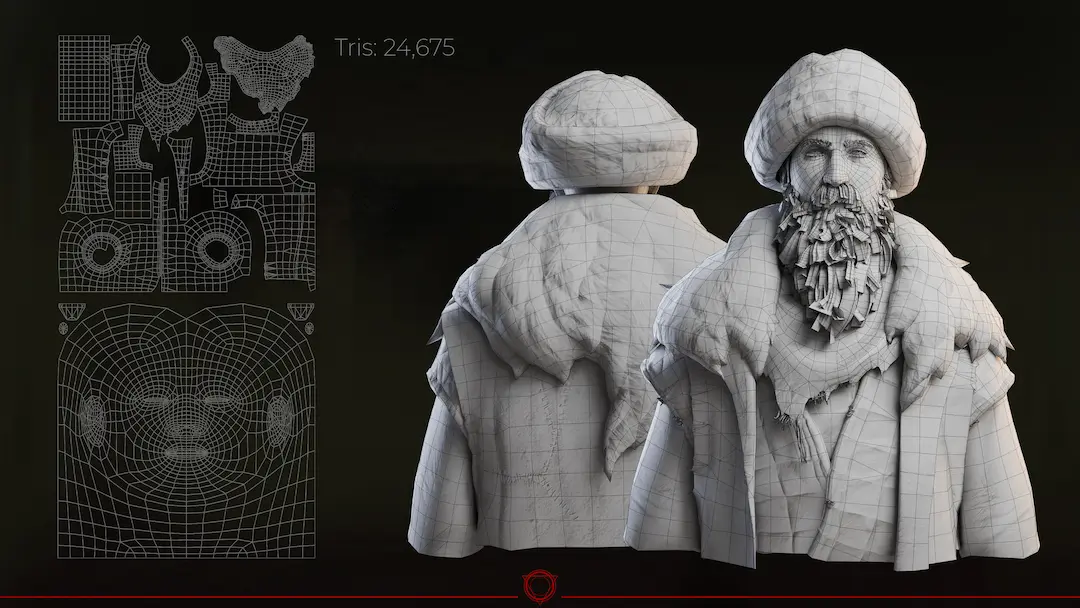
Request a technical breakdown of one or two assets from the portfolio: poly count, UV unwrapping, texel density, rigging joints.
This takes 2–3 days but allows you to understand the real level of production quality, rather than just “beauty in Marmoset.” The problem is that most clients evaluate art purely visually – and miss technical issues that will surface during engine integration.
Step 4. Align: Agree on the TOR, Deliverables, and Milestone Structure
This is the most critical step. For a professional contractor, a TOR is not just a “send us a description” request, but a structured tech spec with a reference package, iteration points, and an approval format for each stage.
VSQUAD embeds its team directly into the client’s Jira/Trello/Perforce at this stage. This way, iterations happen in the same tracker as internal development, without losing context between teams. The milestone structure is fixed in the contract: what we deliver, in what format, and by what deadline.
Step 5. Monitor: Control Progress by Milestones, Not by Feelings
Checking in every 1–2 weeks is not an optional element; it is an obligatory control cycle. At each milestone, there must be specific deliverables: not “work is underway,” but “here are 5 models in an engine-ready state, feedback by Friday.”
VSQUAD works with fixed iteration points built into the contract – so the client always knows exactly where the project stands, rather than just having a vague feeling. This is precisely the workflow format we used on Wayfinder, where the production of over 200 assets ran concurrently.
Step 6. Evaluate: Final Review and Iteration Cycle if Necessary
Final validation is not just “like/dislike,” but a checkup against the original scope document: Are all LOD levels in place? Is the texel density within normal limits? Does the rig work with the target skeleton?
If there are discrepancies, an iteration loop with a fixed resolution deadline is triggered. A professional contractor does not disappear after delivery – they close the cycle properly.
Ready to scale your production without the risk of technical debt?
Tell us about your game, your target platform, and your visual style. Our team will review your requirements and reach out to discuss how we can integrate seamlessly into your pipeline.
Beginners vs VSQUAD: Where the Pipeline Breaks
| Situation | First Time Without Experience | VSQUAD Approach |
|---|---|---|
| Budget Estimation | Approximately $X" without a scope document | Detailed breakdown for each asset type before the start |
| Art QA | Visual check right before the final delivery | Tech Review built into every milestone |
| Rigging for the Engine | The rig is made "correctly" but not for the target skeleton | Rig spec is coordinated with the client's tech lead at Stage 1 |
| Optimization | LODs and draw calls are left for the beta stage | Poly budget and LOD structure are in the TOR before modeling starts |
| Communication | Email + "we'll let you know when it's ready" | Client's Jira/Trello, weekly check-ins, fixed iterations |
| Missing Deadlines | Discovered in the final week | Milestone triggers in the contract allow catching it 3–4 weeks ahead |
About VSQUAD Studio
VSQUAD is a full-cycle outsource studio founded in 2015. Over 10 years, we have achieved 50+ shipped projects, with clients from the US, Norway, Germany, Mexico, and over 15 other countries.
We take on tasks that solve specific production problems: a shortage of art resources during peak loads, asset optimization for platform specs, or a full production cycle from concept to engine-ready delivery.
Our game development pipeline is built on a milestone structure: we enter a project with a detailed scope document, integrate into the client’s tools (Jira, Perforce, Slack), and deliver assets at fixed iteration points. The team is not just a single executor, but an Art Director + artists + a Tech Artist working synchronously.
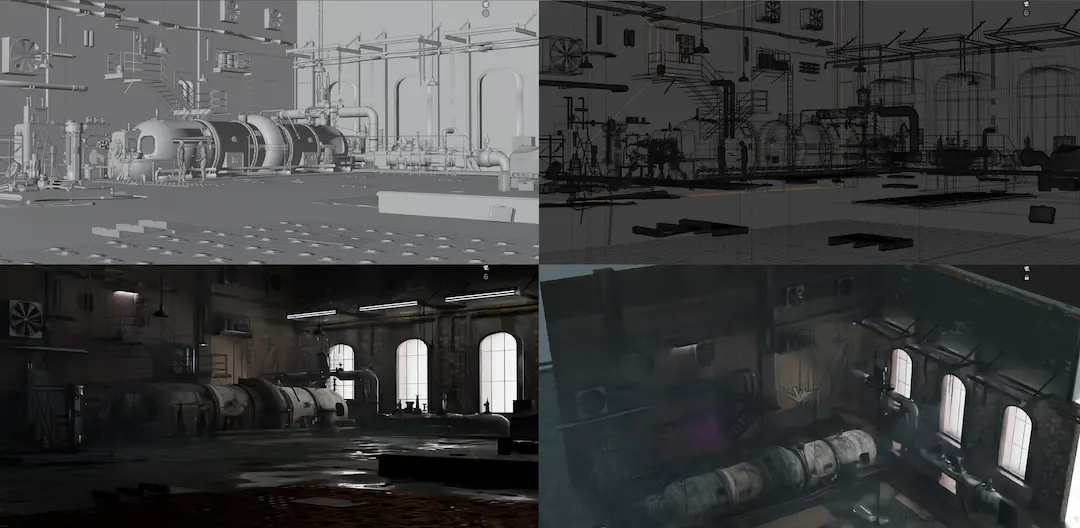
We worked on Wayfinder (200+ characters and assets for Airship Syndicate), Darksiders Genesis, Battle Chasers, Ruined King, and SMITE. Among our indie projects are teams that received Epic MegaGrants and made it to the Steam Festival.
FAQ
The answer to how much does it cost to develop a video game ranges from $10,000 for a simple mobile casual game to $300M+ for an AAA title. A realistic average indie game budget for a PC/Steam game with a team of 5–8 people and a timeline of 12–18 months is $150,000–$500,000 without marketing.
Factors that influence how much does it cost to create a video game include:
– Platform (mobile vs PC vs console)
– Art style (2D flat vs 3D with PBR materials)
– Scope of content (number of levels, characters, mechanics)
– Team location (US vs Eastern Europe – a 2–3x difference in rates)
– Marketing budget (20–100% of production cost)
The basic formula is: (Rate × 8 hours) × (Number of people × 20 working days) × Months of work. Example: 10 people, $40/hour rate, 6 months = $384,000 on team labor alone. Add marketing, engine licenses, QA, and audio to this, and you get the real picture.
Additional line items that are often forgotten:
– QA: 10–15% of the production budget
– Audio and music: $3,000–$30,000+
– Tool licenses and subscriptions: $2,000–$10,000/year
– Unexpected iterations: factor in a 15–20% buffer
A realistic average cost to make a video game for handheld devices varies wildly, but specifically, the mobile game development cost ranges from $10,000 for a hyper-casual game to $600,000+ for a game with geolocation and complex server mechanics (like Pokémon Go). A standard casual mobile title with good art quality costs around $30,000–$100,000.
Key variables for mobile:
– iOS + Android simultaneously = +30–50% to development costs
– Server infrastructure for multiplayer is a separate budget item
– The UA budget for mobile often exceeds the production cost
GTA V cost around $265 million for development and marketing – this is an AAA tier with a team of thousands of people and a multi-year production cycle. A realistic evaluation for a game of comparable complexity (open world, physics, voice acting, LiveOps) ranges from $50M to $300M+.
When analyzing how much does a Triple-A game costs to make, GTA V is a prime example. If you wonder how much does it cost to make a game like GTA, you must account for years of work across the following areas:
– Environment art: hundreds of thousands of unique assets
– NPC AI and animation: thousands of states and transitions
– Narrative and VO: hundreds of hours of dialogue
Yes – through a properly structured outsource pipeline. The key is not “cheaper,” but “more efficient”: paying $2,500 for a production-ready 3D character with correct LODs and a rig for your engine is better than paying $800 for a visually similar model that cannot be used without a complete overhaul.
Where you can realistically save without losing quality:
– Unifying assets (one base-mesh → several variations)
– Outsourcing art production to Eastern Europe while maintaining control over art direction
– Using modularity in environment design
– Building a LOD system from the very start, rather than during the optimization phase
Yes. Part of our portfolio consists of indie projects, including teams with whom we built a production pipeline from scratch. For indie developers, we adapt the scope and milestone structure to fit the budget: we start with key assets that deliver the maximum visual impact, rather than a list of “everything all at once.”
What we can offer to indie teams:
– A flexible milestone structure without a mandatory large upfront payment
– Production-ready assets with a technical spec tailored to your engine
– Integration into your tools (Trello / Notion / Slack)
– Art budget consultation before the start – to avoid overpaying for scope
The Bottom Line for First-Time Developers
Your first game development project almost always goes over budget – not because the team is incompetent, but because there is a lack of experience in the right places. Feature creep, incorrect art production estimation, and technical debt from flawed assets are predictable problems that can be solved with structure rather than luck.
Outsourcing means reducing production risks and optimizing the budget for art and development without inflating the internal team.
VSQUAD is a contractor that solves these tasks through a milestone structure, a Tech Artist in the pipeline from stage one, and integration into your working tools – leaving no room for a “hand over the brief and wait” format.
Contact us → 📩 head@vsquad.art or schedule a call.
Our Game Services
Get in touch
Got a project in mind? We usually reply within a day.