


There are games that are remembered from the very first screenshot. And there are those that you close after 10 minutes – even if the mechanics there are interesting. The difference usually comes down to one thing: the characters. It is not the plot, not the level design, and not the monetization. It is the character that is the player’s first living contact with your world.
The mobile and indie game market has grown so much that visual noise has become the number one problem. Approximately 30–40 new titles are released on Steam every day. In the mobile sector, there are even more. It is impossible to sell gameplay through a single screenshot. Selling a character, however, is possible. This is exactly why studios that skimp on 2D character art design services do not just lose money on art. They lose conversions, ratings, and their audience.
Why "Just Drawing" is Not a Strategy
Newcomers to game development often think the same way: “Let’s find a cheaper freelancer, they will draw the characters, and we’ll figure out the rest later.” I understand the logic. The budget is limited, deadlines are tight, and you need to save money somewhere.
The problem is that an art pipeline is not just an illustration. It is a system. If it is built incorrectly from the outset, you will have to pay for it twice: first to the freelancer, and then for a complete redesign three weeks before the release.
Here is exactly what goes wrong for teams without experience in working with a 2D character design development company:
Lack of a unified visual language. One character is drawn in a dense, saturated style, while another is a light sketch. On the screen, they look like they come from different games. The player picks up on this instantly – and trust in the project collapses.
The technical part is ignored. A visually stunning concept that is functionally impossible to rig or animate properly is a wasted budget. High-quality 2D character art services imply an understanding of how the art lives inside the engine, how it will move, scale, and be displayed on different devices.
No systematic approach to revisions. With a freelancer, every edit is a negotiation. With a professional studio, edits are built into the process: iterations, a clear feedback cycle, and final approval.
My advice: do not waste time searching for “that one” freelancer with a portfolio for half the price. Either you find someone who understands the game development pipeline, or you pay twice.
What Sets a Professional Approach in 2D Character Art Apart
Professional 2D game character design services for games begin long before the first sketch. Here is how it looks in practice.
Art Directing: Concept First, then Pixels
Before an artist opens Photoshop or Procreate, several questions must be answered. Who is the target audience? What is the emotional tone of the game? How does the character look compared to competitors on the same platform?
According to the official Epic Games documentation on setting up characters in Unreal Engine, creating art assets is the most complex part of the entire character development process, requiring the refinement of design, modeling, rigging, and animation even before the first touch of the engine. This directly emphasizes that proper preparation at the start streamlines the workflow and reduces costs at every subsequent stage.
At this stage, the following are formed: the color palette, silhouette language, proportional system, and key visual rhythms. This is where a 2D character design agency differs from just a “studio with a portfolio” – through systematic thinking.
Rigging and Animation Requirements from the Start
One of the most frequent failures in a pipeline is when art is created in isolation from animation. A character looks great statically, but when it comes to rigging, it turns out that the proportions do not allow for a normal walking cycle, costume details overlap during movement, and overall – it needs to be redone.
Professional custom 2D art development services assume that the artist and animator work in tandem from day one. Layer marking, geometry cleanliness, and correct export – all of this is built into the process rather than being discovered at the last moment.

Fun Fact
The first commercially successful 2D character in video game history – Pac-Man (1980) – was created without a single sketch on paper. Toru Iwatani came up with his shape while looking at a pizza with a missing slice. Today, the development of even a simple game character involves dozens of iterations of concepts, color schemes, and animation tests – the gap since 1980 is huge, but the principle remains: everything begins with an idea.
Texel Density and Scaling for Platforms
While often associated with 3D, texel density is equally vital in 2D development. It is about how detailed the art should be at a specific resolution and on a specific device. A character that looks gorgeous on a 4K monitor might turn out to be a blurry spot on a mobile screen – or conversely, overloaded with details that are not readable at all.
According to Statista: Global games market revenue by device, the mobile segment accounts for about 49% of the global gaming market by revenue – approximately $92.6 billion in 2024. This means that most clients are thinking about cross-platform compatibility in one way or another. This must be integrated into the art requirements from the start.
Consistency as a Production Standard
One of the main KPIs of a 2D game character design studio is the predictability of the result. It is not about being “beautiful,” but about being “beautiful and consistently good” for all 40 characters in a batch. A unified library of elements (hairstyles, accessories, skin textures), clear style guidelines, and quality control at every stage – this is what provides truly scalable production.
That’s precisely why distinguishes 2D characters design outsourcing with proven studios from working with a pool of different freelancers: you do not just get a set of pictures, but a system.
Technical Readiness Standards for Production-Grade 2D Assets
| Technical Parameter | Freelance/Amateur Level | Professional Studio Standard | Impact on Project |
|---|---|---|---|
| Silhouette "Thumb" Test | Focus on aesthetics only. | Distinctive shape recognition at 5% scale & monochrome. | Instant player recognition in chaotic gameplay. |
| Anatomical Pivot Points | Joints placed visually. | Articulated joints aligned with skeletal rig constraints. | Natural deformation during 2D animation (Spine/Live2D). |
| Color Value Contrast | Random color picking. | Values strictly balanced (Light/Mid/Dark) for readability. | Prevents characters from "blending" into the background. |
| Layer Organization | Merged or poorly named layers. | Full naming convention (L_Arm_Upper, R_Eye_Blink) + hierarchy. | Reduces integration time by 40-60% for technical artists. |
| Texture Atlasing | Single large files. | Optimized for Power of Two (PoT) and sprite packing. | Significant reduction in Draw Calls and VRAM usage. |
| Asset Modularization | Static unique drawings. | Parts-based design (swappable gear, skins, expressions). | Enables scalable content updates and microtransactions. |
Beginners vs. Pros: Concrete Comparisons
Let’s look at some real-world scenarios – straight to the point.
Scenario 1: Indie team, 12 characters, mobile.
They went with freelancers. They received 12 very different styles. They spent 2 months on “unification.” In the end – a redesign of 7 out of 12 characters. Total expenses were 1.8 times higher than if they had worked with a studio from the start.
Scenario 2: Mid-size team, RPG, Steam.
They turned to VSQUAD Studio at the concept art stage. We built a visual guideline and developed 5 key characters as a benchmark against which the entire team was scaled. The result – when one artist got sick, their tasks were picked up by another without any loss of style. The project was released on time.
Scenario 3: Small publisher, casual mobile.
They came with 80% of the art already completed by freelancers and asked us to “bring it to perfection.” In reality – a complete redesign of the main character and two supporting ones was required. This was because the original art could not be animated: layers were not correctly separated, and limb proportions did not meet the engine’s rig requirements.
These are not unique cases. This is a standard story.
Why choose custom 2D art development services?
If you want your game to stand out in a saturated market, “off-the-shelf” solutions or random art assets won’t cut it. Custom 2D art development services ensure that every visual element – from the primary hero to the smallest UI icon – is tailor-made to support your unique gameplay mechanics and narrative. By choosing specialized custom 2d art development services agencies, you invest in a scalable production system, technical compatibility with engines like Unreal or Unity, and a cohesive visual identity that drives player retention.
About Us: How VSQUAD Studio Solves These Tasks
VSQUAD Studio has been working in game art outsourcing since 2015. During this time, we have completed over 50 successful projects, working with teams from the USA, Norway, Mexico, Germany, Finland, and other countries. Our art has participated in Steam Festivals and Gamescom Latam, and several projects have received funding through Epic MegaGrants.
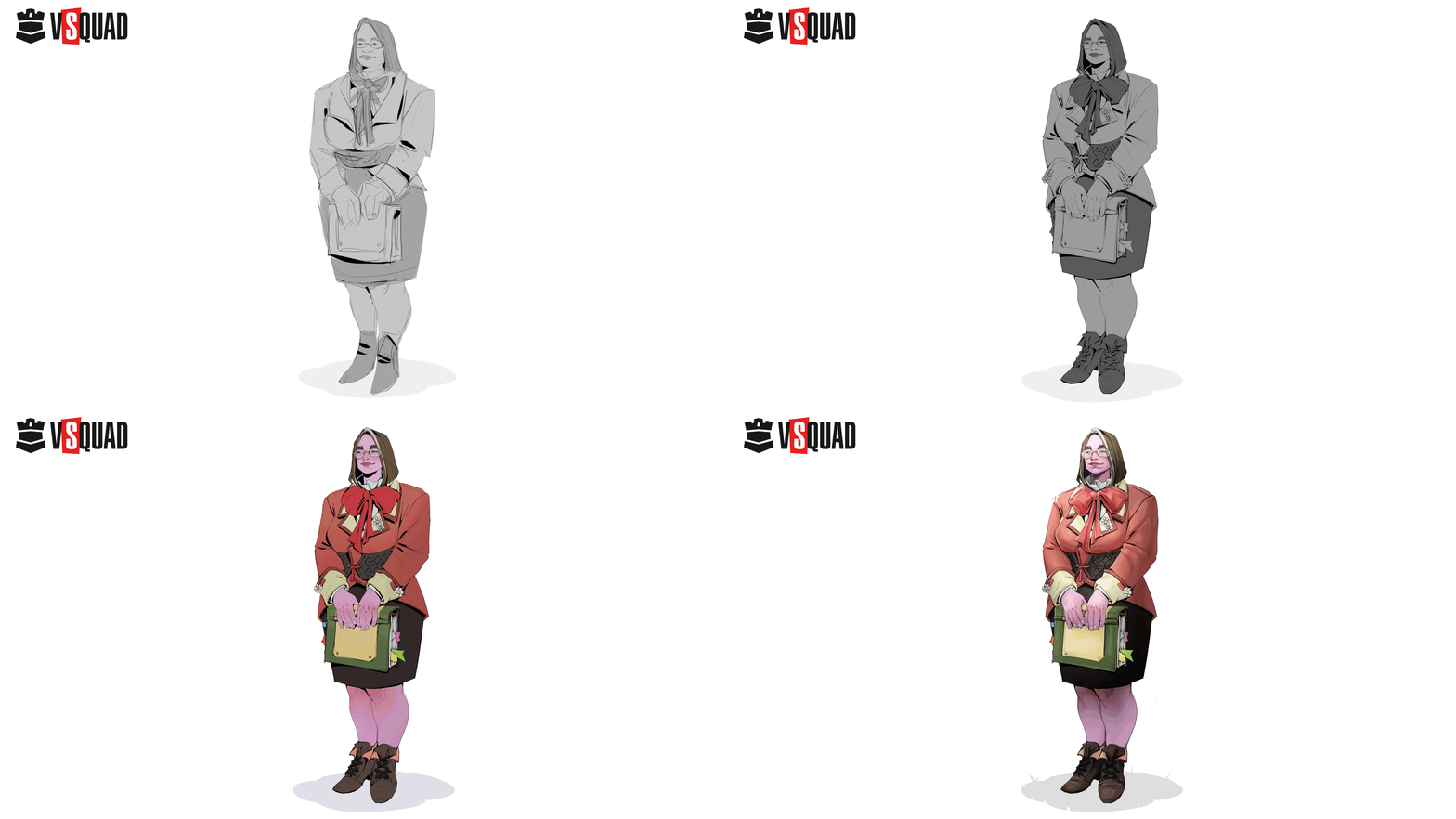
When it comes to providing custom 2D art services, we do not just draw. We build a pipeline specifically for your team. We can connect within 48 hours. We provide a full team: concept artists, line artists, colorists, animators, and technical specialists. We work in Unity, Unreal Engine, and Godot.
As winners of the “Consumer Choice 2024” award – an independent industry evaluation, not a self-presentation – our clients receive not just art, but a predictable result: deadlines, quality, and transparent communication at every stage.
If you are looking for character design companies that offer leading 2D art design development services with a proven track record, take a look at our portfolio.
FAQ
The price depends on the complexity of the style, the number of characters, the level of detail, and the presence of animation. A simple mobile character with a basic set of animations is one budget; a detailed RPG hero with lore, multiple skins, and facial expressions is quite another. At VSQUAD Studio, we always provide an estimate after a briefing rather than from a fixed price list – this is fairer for both parties.
All rights to the final assets are transferred to the client in full. We reserve the right to use the work in our portfolio – unless the client requests an NDA. If confidentiality is critical, we sign a corresponding agreement before starting. Among custom 2D art development services agencies, we prioritize the legal security of our clients’ IP.
This is a standard situation. Within the project, we provide rounds of revisions at every stage – concept, line art, and final color. After delivery, we work by agreement. There is no such thing as “we have already closed the task, goodbye.”
Within 48 hours of signing the contract and receiving the brief, we are ready to join your process. This isn’t just marketing talk; it’s our operational standard for custom 2D art outsourcing services.
Deadlines are fixed in the contract. If we see a risk of delay, we inform you in advance, not the day before the deadline. In our practice, missing deadlines is a rarity because we build in a buffer for the unforeseen during the planning stage.
Yes, and this is a frequent situation. We are skilled at stepping into an existing visual style, adapting to already approved guidelines, and organically continuing the work of another team. Simply provide us with references and a style guide – we will figure it out.
Ready to Discuss the Project?
If you have read this far, the question of art for your game is likely already on the agenda. This is a good time to talk. Not about abstract “cooperation,” but about specific tasks, deadlines, and budgets.
Email us: head@vsquad.art
Book a call: calendly.com/head-vsquad
VSQUAD Studio – your art, your deadlines, without compromises on quality.
Get in touch
Got a project in mind? We usually reply within a day.