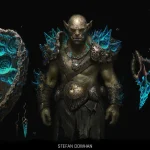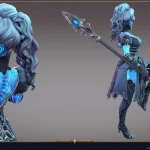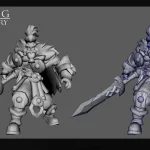



Studios hand over their concept art to 3D art outsourcing companies – and then end up completely redoing it from scratch. This does not happen because the contractor drew poorly. It happens because no one asked at the start: which engine is it for, what is the target hardware, how many draw calls are allowed per character, and what texel density is required for the target resolution?
The concept looked gorgeous in Photoshop. But in the engine, it results in an extra 40% of polygons, which dragged down modeling, rigging, LOD creation, and mesh optimization. The milestone is missed. The budget has ballooned. The team is burning out.
This is not a rare edge case – it is a standard story that I have seen across dozens of projects. And it almost always starts not with poor artists, but with a leaky process when collaborating with 3D outsourcing companies.
Why Studios Outsource 3D Concept Art
Narrow Expertise That is Lacking Internally
A good concept artist for 3D is not simply someone who knows how to draw. They must understand how their sketch translates into a 3D mesh, where to simplify the silhouette for the sake of rigging, and how PBR works in a specific game engine.
Such specialists are rare in the market. Keeping them on staff for a single project is expensive. Partnering with a 3D game art company provides access to them exactly when needed.
Economics: Not a Slogan, but Numbers
A full-time senior concept artist in the US costs a studio around $80,000–$120,000 per year, including taxes and benefits. Outsourcing that same task to a proven 3D game art outsourcing company costs $3,000–$12,000 per project, depending on the volume.
Even with a moderate annual workload, the cost difference is multi-fold. Furthermore, you do not pay for idle time between projects.
Speed and Scale for Peak Loads
Pre-production and production require entirely different workload capacities. During the concept phase, you might need 3–5 artists simultaneously; in the middle of the project, just 1–2 are enough.
An internal team cannot scale to match peak demands without additional hiring, leaving you with staff you no longer need later. Reliable 3D game art partners cover peak loads within 48–72 hours without requiring in-house recruitment.
A Fresh Perspective on Visual Solutions
An internal team works within the same context for months and stops noticing obvious flaws: broken character readability against a dark background, repetitive shape language across all assets, or stylistic drift between different artists.
An external art director spots this immediately – because their vision remains sharp and unbiased.
Reducing Technical Debt
A concept created without considering production constraints accumulates technical debt throughout all subsequent stages: modeling, retopology, rigging, and animation.
A single poorly thought-out character concept adds 15–20% more time to every subsequent production stage. An outsourcing studio that includes a Technical Artist in its team catches these issues before they ever enter production.
Where and Why 3D Concept Art Outsourcing Breaks Down
Most often, the pipeline cracks in one of three places.
First – technical specifications without technical constraints. A studio sends over a brief: “warrior character, dark style, realistic.” The contractor delivers the artwork. It looks beautiful. However, no one specified the target platform – mobile, the draw calls budget – 50 per character, or the engine – Unity URP. When the concept is handed over for modeling, it turns out that the level of armor detail is physically impossible within the allocated polygon budget. Redoing the concept takes 2 weeks, leading to a missed milestone.
This happens not because the freelancer lacks competence. This happens because there were no technical specs in the brief, and a freelancer doesn’t have a dedicated 3D game art team to ask the right questions before work begins.
Second – a complete absence of iterative control. Studios frequently assign a task and simply wait for the final result. The contractor works for 3–4 weeks and delivers the final asset – only for the studio to discover that the style drifted off course during the very first iteration. It is too late to redo it, and the budget is spent. The correct approach involves a checkpoint after every iteration: rough sketch → refined concept → final. Each stage is approved sequentially, allowing deviations to be caught early on rather than at the finish line.
On Darksiders Genesis, we worked exactly this way: before the artists dove into detailing Strife and War, the Art Director approved the silhouettes and color keys. This saved at least one full iteration on every single character.
Third – handing over a concept without proper handoff documentation. The concept is approved – great. But the 3D artist receives no turntable, no material breakdown, and no instructions regarding detail priority zones. This triggers endless questions that could have been resolved with a single document at the start. On Battle Chasers, we standardized the handoff package: concept sheet + material callouts + reference board + technical notes. The time spent resolving questions was reduced dramatically.
According to the official Unreal Engine documentation on mobile optimization, a high draw call count is the primary factor behind poor performance, and the number of draw calls depends directly on the number of unique meshes and material IDs on each of them. This is not just theory; it is a major pain point highlighted by Epic in their official guidelines – and it is exactly what a concept created without technical constraints generates.
What Exactly Can Be Delegated: The Scope of Outsourcing
Many studios are hesitant to delegate “strategic” art externally. In reality, the boundary is defined differently.
It is logical to delegate:
– Character concept art (including hero shots, turntable refs, expression sheets)
– Environment concepts (key art, location breakdowns, mood boards)
– Concepts for props, weapons, and vehicles
– Style guide development for a specific engine and platform
– Iterative polish of concepts to a production-ready state
– Technical concepts with material breakdowns for the PBR pipeline
– Concept-to-3D handoff packages
– VFX concepts and motion references
It is better to keep in-house:
– Final approval of the visual direction (this must be handled by your internal Art Director)
– Brand-critical decisions that impact marketing and IP
– Concepts tied to unrevealed narrative elements without strict NDA control
If you do not have an in-house art director – this can also be delegated, but then you should choose a comprehensive 3D game art development company where an AD is included by default rather than being hired separately.
How the Process Works with an Outsourcing Studio: 6 Steps
A professional contractor does not follow a “get the brief – disappear for three weeks – send the final” scheme. A structured process looks like this:
1. Define the Scope and Technical Constraints (Define)
Before any work begins, the following parameters are locked in: target platform, engine, polygon budget, draw call limits, texel density, render color profile, and milestone deadlines. Without this data, a concept might look beautiful but remain completely unusable for production. This stage typically takes 1–3 business days for synchronization and approval of the technical brief.
The problem without this step: an artist draws details that physically cannot fit into the polygon budget of a mobile platform. The consequence is a complete rewrite of the concept after it has already moved to modeling. At VSQUAD, our Tech Artist fills out the technical brief alongside the client before any task begins.
2. Choose a Contractor by Profile, Not Portfolio (Research)
The mistake most studios make is choosing 3D game art companies based on the visual appeal of their portfolio alone, without checking if they have hands-on experience with your specific engine and platform. ArtStation images won’t show whether a team knows how to work with Lumen in UE5 or optimize assets for Nintendo Switch. The correct selection criteria include: relevant case studies in your genre and on your platform, a team with a Tech Artist or AD, and a transparent milestone structure in the contract.
3. Conduct a Technical Portfolio Validation (Review)
A beautiful concept and a production-ready concept are two different things. When evaluating a 3D game modeling art studio, check if they provide examples of concepts with material callouts, proper handoff documentation, and if they design concepts with rigging zones in mind. Ask for a breakdown of one of their past projects to see exactly how they handed the concept over to 3D. If no breakdown is available, consider it a red flag.
4. Align the Technical Specifications, Deliverables, and Milestone Structure (Align)
At this stage, everything is formalized: exactly what gets delivered at each iteration, the file formats (PSD/PDF/PNG + refs), who approves the work on the client side, and the deadlines for each checkpoint. Having a dedicated team instead of a single freelancer is critical here: the Art Director and concept artist work in sync, rather than a lone freelancer doing everything themselves and trying to handle their own approvals. Milestones are explicitly written into the contract – not agreed upon verbally.
5. Monitor Progress via Checkpoints (Monitor)
Regular check-ins are a core part of the process, not an option. The format includes a weekly status update in Slack or Jira, intermediate deliveries by iteration (rough → refined → final), and documenting all feedback in writing. We integrate directly into the client’s pipeline – whether it’s Perforce, Jira, Notion, or Slack – rather than forcing them into our tools. On Ruined King, every piece of concept art underwent three sync cycles with the Airship Syndicate team before finalization. While this sounds time-consuming, it actually cuts total iterations in half.
6. Evaluate the Results and Close the Iteration Cycle (Evaluate)
The final review is far from a mere formality. It is a rigorous validation check: does the result perfectly match the technical brief from step 1? Are there any stylistic discrepancies compared to the approved reference samples? Is the concept ready to be handed over to 3D without triggering extra questions? If discrepancies are found, the iteration is reopened. The number of iterations is locked into the contract: a standard character concept includes 3 iterations, while a complex environment allows up to 5.
Ready to hand over your brief to a team that actually speaks your engine’s language?
Stop gambling on your next milestone. Visit our 3D Game Art category, choose your genre, and let’s build an unburnable production pipeline together.
Beginners vs. VSQUAD: What is the Difference in Practice
| Situation | Typical Contractor | VSQUAD |
|---|---|---|
| Brief received without technical data | Starts drawing based on random references | Tech Artist requests platform specs before starting |
| First iteration goes off course | You only find out at the final delivery stage | Checkpoint after the rough sketch; deviations spotted by day 3 |
| Concept delivered, 3D team has questions | Just look at the picture | Handoff package: material callouts, rigging zones, LOD notes |
| Need to scale up - 3 characters in parallel | Freelancer takes it all, gets overwhelmed, and misses deadlines | Parallel artists guided by an AD, ensuring style consistency |
| Deadline is tight, revision needed at stage 4 | Demands extra payment or says "I won't make it" | Milestone structure with built-in buffers; revisions fixed in contract |
| Client operates in Jira + Perforce | Send it to me via Telegram | We integrate into your tracking systems within 48 hours |
The difference isn’t just in the “drawing quality.” It lies in whether the provider delivers tailored custom 3D game art studio solutions backed by a real process, or just Photoshop files.

Fun Fact
According to the official Unity Manual on character optimization, the recommended polygon range for mobile characters is 300–1,500, while desktop characters range from 1,500–4,000. Real AAA console hero characters can easily feature 80,000–150,000+ triangles. This is a 50x to 100x difference – and it explains why a concept drawn purely “for beauty” without targeting a specific platform almost guarantees production headaches.
Get a free audit of your concept pipeline with a VSQUAD Art Director.
We will show you exactly where your process breaks down and what can be fixed before your next milestone.
About Us
VSQUAD Studio is an outsourcing studio with 10 years of experience in game development. We work with teams ranging from indie developers to AAA giants, delivering 3D characters, environments, props, vehicles, hard-surface assets, animations, and VFX. We provide a full production cycle – from initial concept to production-ready asset.
What sets us apart from “just artists” is that every single task is handled by a combined unit: Art Director + Technical Artist + Lead Artist. We don’t rely on a lone freelancer who acts as their own art director. We integrate into your pipeline – Jira, Slack, Perforce – within 48 hours. Our milestone structure is locked into the contract, and all iterations are agreed upon in advance.
Some of the notable projects where we built this exact pipeline include Darksiders Genesis, Battle Chasers, Ruined King, Wayfinder, and SMITE. The studio was awarded “Consumer Choice 2024” by an independent industry analytics group.
The mistake most studios make is choosing a 3D game art design company purely based on aesthetics, but our 3D game art solutions cover the entire spectrum – from stylized characters to realistic military assets. As a versatile 3D game art studio for console games and mobile titles, we adapt to any technical environment.
FAQ
A single character concept ranges from $150 to $800 depending on complexity and the required level of detail. A package of 5–8 characters for a mobile project starts at $2,500. A complete pre-production package containing character, environment, and prop concepts for an indie project starts around $8,000.
The final price is influenced by rigging complexity, the number of material breakdowns, whether handoff documentation is required for the 3D team, and deadlines. We provide an exact estimate after a 30-minute briefing session – completely free of charge and with no upfront commitments.
Upon final payment, all intellectual property rights to the concept art transfer completely to the client. This is explicitly laid out in the contract before any work begins.
Standard terms in our contract include:
– Complete transfer of IP rights following the final payment
– A strict ban on portfolio publication prior to an agreed date (typically game launch or 6 months post-release)
– Full delivery of all source files (PSD, AI, layered files) as part of the final deliverables
The number of allowed iterations is explicitly defined in the contract prior to launch. A standard character concept includes 3 iterations built into the price. If additional revisions are requested, they are billed at an agreed hourly rate.
That said, a well-structured process utilizing checkpoints after each iteration makes a “scrap everything and redo it at the end” scenario exceptionally rare. Across our last 50+ projects, final revisions exceeding contract limits occurred in fewer than 10% of cases.
Deadlines are fixed within the milestone structure of the contract, never just verbally. A standard character concept (hero shot + turntable + material breakdown) takes 7–14 business days. An environment concept takes 14–21 business days.
If we miss a milestone without prior written agreement from the client, it constitutes a direct breach of contract. In practice, given a solid brief and pre-aligned technical specs at the start, deadlines are met in over 95% of cases.
We operate entirely within the client’s preferred toolset – Jira, Notion, Trello, Slack, Perforce, or Google Drive. We do not force you to migrate to our internal systems.
Standard onboarding takes less than 48 hours to configure permissions and conduct an initial alignment call. From there, our team is fully embedded in your environment – tracking tasks, leaving comments in your tracker, and delivering work directly into your production pipeline. This is our baseline standard of operations, not an extra fee add-on.
Yes. Roughly one-third of our client roster consists of indie studios with teams of fewer than 10 people.
There is no minimum task volume restriction. We handle isolated concepts (such as 1–3 characters) just as eagerly as comprehensive pre-production packages. Whether you need a specialized 3D game art studio for VR/AR projects or a lightweight mobile prototype, we tailor our workflow accordingly.
For indie teams, this is especially valuable: while we do not enforce minimum budget thresholds, we maintain our strict workflow quality standards – a technical brief, milestone roadmap, and handoff documentation are mandatory regardless of project size.
Ready to Scale Your Pipeline?
Concept art outsourcing is far more than a “hand over the brief and forget it” task. It is a powerful instrument that either accelerates your production pipeline or completely derails it – depending entirely on whether your contractor follows a real technical process.
Failures occur in highly predictable patterns: a lack of an upfront technical brief, an absence of iterative checkpoints, and missing handoff documentation. Each of these gaps tacks on 1 to 3 weeks of expensive, unexpected re-work.
Outsourcing = technical debt mitigation and predictable timelines under peak loads.
VSQUAD = a contractor with technical reviews embedded directly into the pipeline, an Art Director on your team from day one, and a milestone roadmap legally guaranteed before launch.
Ready to discuss your project? Contact us → 📩 head@vsquad.art or schedule a call.
Our Game Art Services
Get in touch
Got a project in mind? We usually reply within a day.