


The market is overheated. You open ArtStation and see hundreds of artists, each promising “top-tier quality” and a “personal touch.” You open Upwork, and there are thousands more. How do you choose someone who will actually complete the task rather than let you down at the final release stage?
Making a mistake when selecting 2D character designers is not just about lost money. It means missed deadlines, endless revisions that lead nowhere, and art that simply does not fit the engine.
I have been through dozens of these situations on the production side. I have seen indie teams lose 3–4 months because of improper artist onboarding. I have seen AAA studios rework entire batches of assets because a freelancer failed to consider sprite sheet requirements. This text is an attempt to give you a working framework, rather than just another list of generic “portfolio-review” tips.
Why “Just Finding an Artist” Does Not Work
Suppose you found someone with a beautiful portfolio. The style fits. The price is right. You signed the contract – and then it begins.
The first deadline slips. Then the second. Revisions do not fit within the agreed-upon scope. The final sprite does not match the texel density of your atlas. Or even worse – the artist does not understand what a proper UV layout for a 2D rig is, and you end up with a character that is impossible to animate without a complete redraw.
This is not a rarity; it is the norm in the freelance market. The reason is simple: most artists work in isolation from the actual production pipeline. They know how to draw – but they do not always know how to produce assets according to technical game dev standards.
A truly professional 2D character artists is not just someone who draws well. It is someone who understands that the final result must function in the engine, pass through rigging, fit into the overall visual style, and not tank the game’s performance.
What to Really Look for in a 2D Character Artist Portfolio
Most clients evaluate a 2D character artist portfolio based on the “I like it / I don’t like it” principle. This is understandable, but insufficient. Here is what you should check additionally:
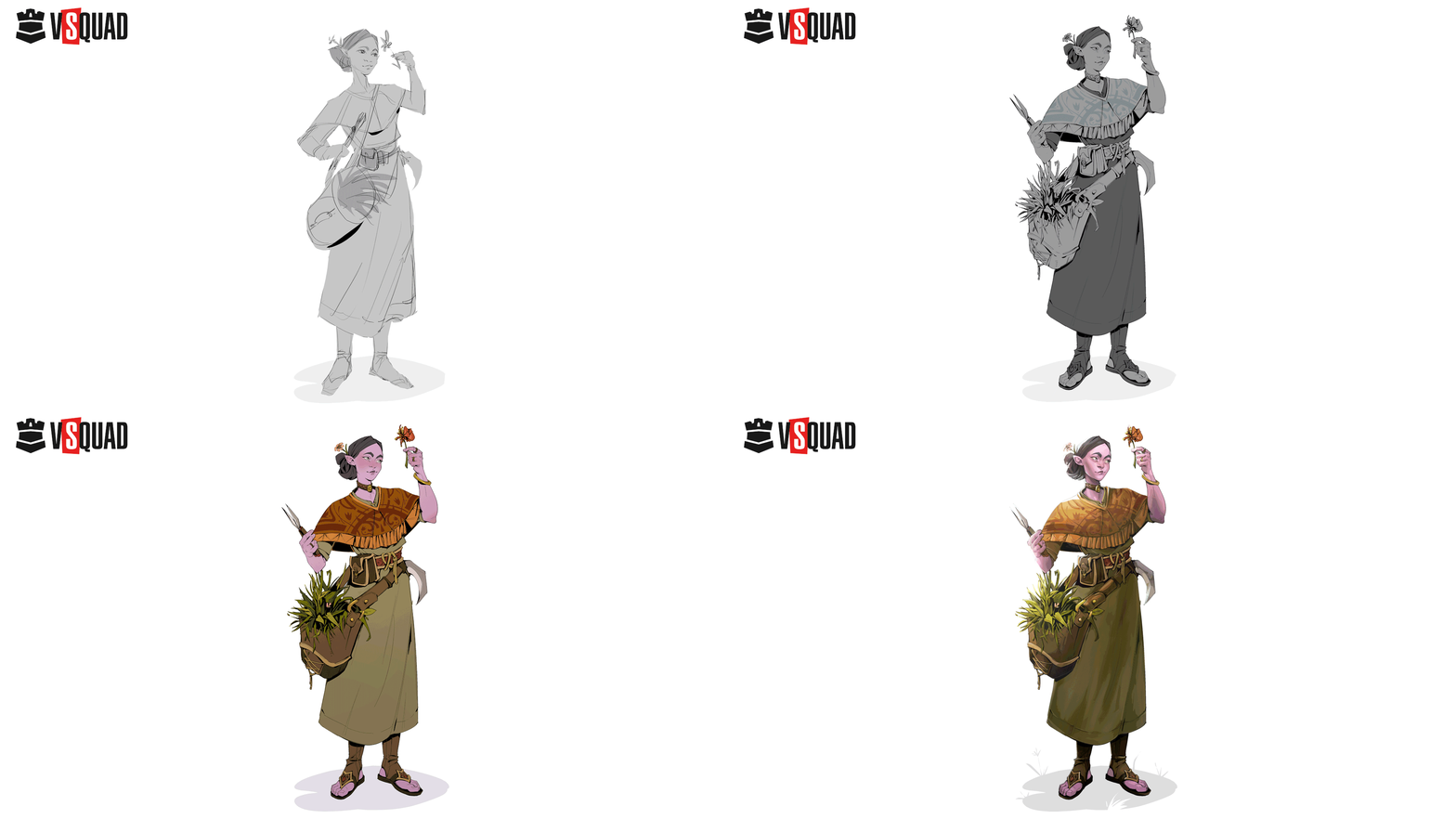
Technical Literacy. Is there a correct layered structure in the works? Does the artist show not just the final piece, but also the layer breakdown, turnaround sheets, and variations? This is a sign that the person has worked in actual production, not just drawn for themselves.
Genre Alignment. Creating a stylized 2D character design for a mobile idle RPG and a 2D realistic character for a narrative game are fundamentally different tasks. The portfolio should contain works in the specific style you need. Versatile artists are rare.
Experience with Animation Rigs. If the character will be animated in Spine or DragonBones, the artist must understand how to construct the body for subsequent rigging. Incorrectly drawn layer overlaps result in a nightmare for the animator later on.
Working with Guidelines. Ask to see a project where the artist worked according to someone else’s style guide – not creating their own, but strictly following an existing one. This is a key skill for production.
As experts note in Game Developer, a vague technical assignment is one of the main reasons for protracted iterations and budget overruns when working with external artists. Beautiful art is only half the battle.

Fun Fact
Did you know that Mario’s iconic look was born entirely out of technical limitations? His mustache was added because 8-bit graphics made it impossible to draw a realistic mouth, and his cap saved artists from the complex task of animating hair movement. This is a classic example of how understanding technical constraints – just like the sprite sheets and texel density we discussed above – can lead to a world-famous character design even on a tight budget.
Technical Readiness: 2D Asset Delivery Standards by Animation Type
This table outlines specific technical requirements that distinguish a “production-ready” artist from a simple illustrator. Use this as a checklist for your technical assignment (TA).
| Animation Approach | Layering & Structure Requirements | Joints & Bone Hierarchy | File Optimization | Red Flags for Production |
|---|---|---|---|---|
| Skeletal (Spine/DragonBones) | Separate limbs, eyes (pupils/whites), and "hidden" parts (e.g., full shoulder behind a torso). | Defined joint centers; consistent naming conventions (L_arm, R_leg). | Meshes with optimized vertex count; minimal transparent padding. | Single-layered PSD; overlapping parts drawn as one piece. |
| Frame-by-Frame (Traditional) | Each frame on a separate layer or within a dedicated sprite sheet grid. | Consistent registration points across all frames to prevent "jittering." | Power of Two (PoT) texture sizes (e.g., 1024x1024) for engine efficiency. | Inconsistent line weight or color shifts between frames. |
| Live2D (Virtual Avatars) | Extreme slicing (separated eyelashes, mouth internals, hair strands). | Deformable meshes with high density for smooth facial expressions. | High-resolution source (4000px+) to allow for close-up zooms. | Merged facial features; lack of "texture padding" or "bleeding" on edges. |
| Static / Procedural (Unity/UE) | Modular attachments (swappable weapons, hats, armor pieces). | Center-bottom or center-mass alignment for correct physics colliders. | Texture Atlases to minimize Draw Calls in-engine. | Hard-baked shadows that conflict with dynamic in-game lighting. |
Simple vs. Stylized: Where the Trap Lies for the Client
Many people think that simple 2D character design is just cheaper and faster. Generally, yes, but there is a nuance that is often overlooked.
A minimalist style requires surgical precision in shape and silhouette. One wrong curve, and the character looks “cheap” instead of “laconic.” Artists who can execute a simple design convincingly are fewer than you might think. It is a distinct skill.
With stylized 2D character design, things are different. There is more freedom in the details, but you need a rigid internal logic: proportions, tonal solutions, and stroke character – everything must work as a system. Otherwise, you get a “jumble of styles” instead of an identity.
A 2D anime character creator is a separate story entirely. The anime aesthetic is incredibly popular in mobile game dev and gacha games, but it has strict rules: proportions, facial typing, and the color temperature of skin tones. An artist who is not specifically immersed in the anime pipeline will draw something “similar,” but it won’t be right.
My advice: before discussing style with an artist, gather a reference board of at least 20–30 images. This will save more time than any text description.
Why You Should Not Skimp on Professionals
There is a temptation to hire a beginner artist for less and “save money.” In practice, this only works in one case – if you have an internal art director with experience who is willing to spend several hours a day on mentoring and corrections.
If such a person is not available, professional 2D character artists pay for themselves through speed and predictability. They do not ask basic questions ten times. They immediately understand what it means to “save in PSD with the correct layer structure for Spine.” They do not break the pipeline.
Why Choose Professional 2D Character Artists?
It is not an overpayment; it is an investment. Because the hour of an experienced artist costs less than two hours of redoing work, plus an hour of an art director’s time for explanations, plus a release delay.
There is another argument. Unity’s official documentation emphasizes that correctly prepared sprite assets directly affect game performance: draw calls, texture atlases, and compression. An artist unfamiliar with these requirements will hand over assets that the technical team will eventually have to rework. And that costs money.
2D Character Layout Artist: A Role That Is Often Underestimated
In animated projects and games with cutscenes, there is a specific specialization – the 2D character layout artist. This is the person responsible for how the character exists within the scene: posing, proportions relative to the background, and staging.
This is not the same as drawing a concept or a final sprite. A layout artist works at the intersection of directing and art. If your game features dialogue scenes, cutscenes, or complex animation – you need this person. Many studios ignore this role and later wonder why the scenes look “flat,” even with excellent art.
Affordable Custom 2D Character Design: How to Avoid Falling for Cheap and Low-Quality Art
This is a sensitive topic. Affordable custom 2D character design is not a myth, but it is also not something you should look for on websites selling icons for $5.
Real savings are achieved not by lowering the artist’s rate, but by optimizing the process. Here is where you can save without losing quality:
– A Clear Brief From the Start. Every iteration of edits caused by a vague brief is money wasted. Spend an hour on a detailed description – save three days.
– A Modular Approach to Characters. If you have an RPG with customization, think through the system in advance: separate layers for the body, clothes, and accessories. The artist draws modules rather than each character from scratch.
– Batch Ordering. Most studios offer a volume discount. Ordering 10 characters at once is more cost-effective than ordering them one by one.
Checking an affordable custom 2D character design portfolio of a studio is the first thing you should do for a reality check: were the projects in this portfolio actually released? Are there links to Steam or the App Store? This means the art passed through a real production pipeline and isn’t just a pretty picture.
How We Do It at VSQUAD Studio
VSQUAD Studio has been working in game dev outsourcing since 2015. Over this time, we have built a system where speed does not contradict quality – within 48 hours, we integrate into your process and provide a full team: artists, animators, and technical specialists.
Why choose affordable 2D character design with us and not see it as a compromise? Because we have worked on projects at the level of Wayfinder, Darksiders Genesis, SMITE, and Ruined King. We understand what a technical assignment means in a real AAA pipeline and apply these standards to projects of any scale – including indies.
Our Art Director, Volodymyr Liubchuk, has over 15 years of experience in game dev. He has seen enough failed pipelines to build one that does not break. We specialize in 2D video game character design in all styles – from simple mobile art to complex realistic or anime directions.
Being recipients of the Consumer Choice 2024 award and participants in Steam Festivals and Gamescom Latam is not for show; it is proof that our projects reach the audience.
FAQ
The range is wide: from $200–$400 for a simple mobile character to $1500+ for a detailed hero with an animation rig, variations, and full documentation. The final price depends on complexity, volume, and style. It is best to request an estimate for a specific brief – we are always ready to discuss it.
Full exclusive rights are transferred to the client after final payment. This is fixed in the contract. We do not use your assets in other projects without written consent.
A fixed number of revision rounds is included in the project – this is specified in the brief before starting. Post-production revisions are discussed separately. Experience shows: a clear brief at the start = minimum revisions at the end.
Deadlines are fixed in the contract. We integrate into a project within 48 hours and work according to a milestone structure – you see progress at every stage, rather than receiving the result on the “last day.”
We adapt to your engine and pipeline: Unity, Unreal, Godot, Spine, DragonBones. If you do not have a technical brief, we will help you create one. Our task is to ensure the assets work in the game, not just look pretty in a PNG.
With teams of any size. We have projects that started as indies and grew to Epic MegaGrants. We scale support to real needs – we can start with one character and increase the pace as the project grows.
How to Choose Correctly - and Not Regret It
Finding the right 2D character designers is not a lottery if you know what to look for. Portfolio, technical standards, pipeline understanding, and transparency regarding deadlines – these are the real criteria, not the number of likes on social media.
If you are currently at the stage of choosing a contractor or just want to understand if your brief is realistic – write to us. We will analyze your task and offer a straightforward solution without the fluff or obligations. Contact us → 📩 head@vsquad.art or schedule a call.
Get in touch
Got a project in mind? We usually reply within a day.