


Finished game worlds often look effortless from the outside. Players see a beautiful forest, a broken pillar, a landmark in the distance, or a dramatic lighting pass and assume it is simply “good art.”
For production teams, those same environments are the result of long planning cycles, technical research, modular asset libraries, lighting passes, performance constraints, design changes, and constant coordination between departments.
Mike Swanson has spent more than 25 years in the game industry across studios including Santa Monica Studio, NVIDIA, Bigpoint, Relic Entertainment, Gas Powered Games, Lucasfilm, Electronic Arts, and Take-Two Interactive. His background spans art management, production leadership, technical art management, lead art, and senior art roles.
In this interview, Mike talks about the production reality of AAA game development and environment art: why simple-looking assets can become expensive, how teams estimate art before everything is known, why modularity and reuse matter, and what smaller teams can learn from AAA workflows without trying to copy AAA budgets.

Main topics:
– AAA environment art
– Game art production
– Environment art budgets
– Modular kits
– Asset reuse
– Lighting production
– Art leadership
– Production planning
– World building
– Small team production lessons
The Reality Behind AAA Worlds
Large game worlds rarely begin with final assets. They usually begin with story, design goals, concept exploration, tech development, and a long period of uncertainty before production becomes stable.
Mike explains that what smaller teams often see as “beautiful art” is actually the result of many departments building toward the same target over a long period of time.
Q: When smaller teams look at AAA environments, they often see “beautiful art.” What do they usually not understand about how those worlds are actually built?
A: Wow, the answer could be a book in itself.
Different studios have their approaches, but most of the time it starts with a story written by the narrative team or director. Then the concept art team comes in and starts hammering out hundreds of conceptual images while working with the Art Director.
As more clarity around the game takes shape, more groups join in.
It can sometimes take a year or more to build up new tech for a game, and even longer to lock down the exact design mechanics. During that time, the art teams are furiously doing R&D and look development.
The environment team will start creating kit and material libraries at this point.
Once you get into the active game art pipeline, everyone depends on every other team for handoffs, and you need a small army of producers to wrangle this.
People quit, people get sick, designs change, and all sorts of roadblocks appear that you have to work around.
My philosophy has always been to use the tool that works best, not necessarily the most popular one. I also always kept an eye out for new tools and tried to foster that same philosophy in my teams.
That is why I loved working in games. It always changes, and there is always something new to learn.
Why Simple Assets Become Expensive
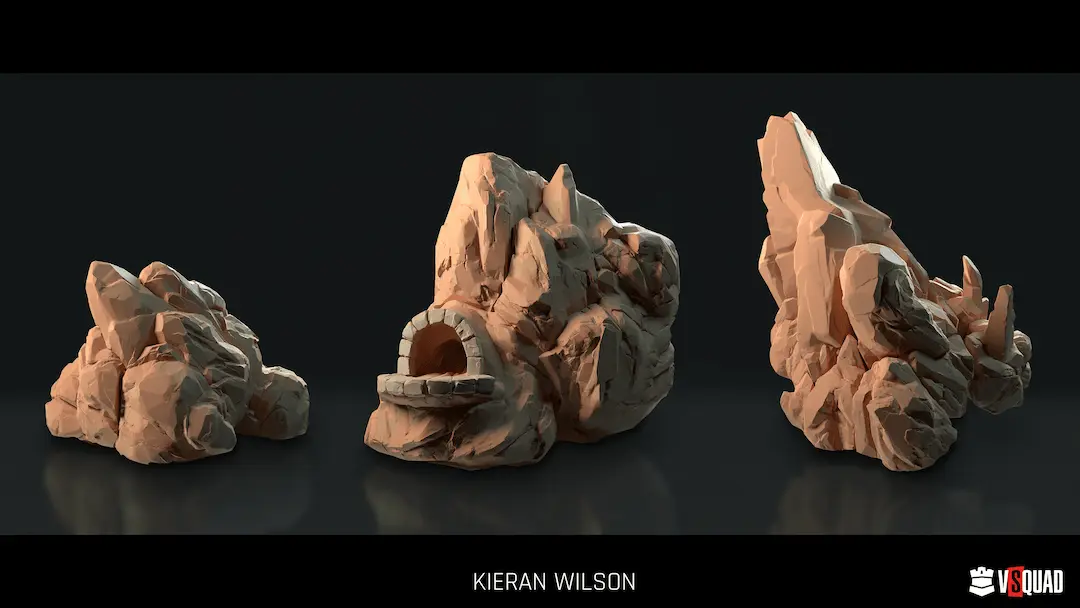
A single rock, stump, wall piece, or broken pillar can look simple from the outside. But in a production environment, that asset often belongs to a larger system.
It may need to work inside modular kits, support variation, hold up across distances, meet memory limits, break apart, animate, or pass optimization and performance checks.
Q: A small team might look at one tree stump, broken pillar, rock, wall piece, or background prop and think: “Why does this take so much time?” What actually makes even simple environment assets expensive on a large production?
A: A lot of times artists will come up with kits, which are dozens of pieces that can be put together in various ways to make an environment seem highly detailed without going over memory limits.
Time needs to be spent ensuring that the individual kit assets do not look repetitive and can be scaled, squashed, or adjusted to add variety.
The kit pieces then undergo LOD optimization, are animated, and even broken apart if they are going to be breakable.
Once the kit is approved, then the official game world building stage begins, with someone set dressing the area of play using those assets.
Estimating Art Before the Game Exists
One of the hardest parts of environment production is estimating work before all details are known.
Experienced teams rely on art leads, senior artists, producers, and sometimes vertical slices to understand what quality level, schedule, and budget are realistic.
Before a full game is built, how do experienced teams estimate the art budget for environments when many things are still unknown?
A: A lot of times artists will come up with kits, which are dozens of pieces that can be put together in various ways to make an environment seem highly detailed without going over memory limits.
A producer will work with them to help with the math of how many days are in the schedule and what the budget is.
If a lower budget is required, then the senior artist can suggest ways to cut back or leverage game art outsourcing without cutting too much quality.
In some cases, if something is very risky, the team may need to do a slice of an environment to understand how much effort it will take to reach the required quality bar.
Q: Is it true that large teams divide environment assets into tiers by complexity, cost, and production risk?
A: Certainly.
The bigger the game, the more specialization and compartmentalization there will be around art creation.
Teams try to spread the love around in terms of who gets the coolest things to work on, but there are some very complex tasks that only senior technical environment artists can take on.
Modular artists might focus on interactable objects. Breakable artists will focus on breaking things.
It is easier to be a generalist at a smaller studio. At a large studio, you need to know a lot about everything, but also have a superpower you bring to the table. For example, maybe you can make rocks that are hyper-realistic.
Modularity, Reuse, and Production Scale
AAA worlds often rely less on constant uniqueness and more on smart reuse.
The challenge is not simply reusing assets, but reusing them in ways that still feel intentional, varied, and appropriate for the world.
Q: In large action-adventure games, how much of an environment is unique art, and how much is smart reuse, modular kits, variations, and production planning?
A: Modular kits are the way to go, and then they are augmented by hero assets.
Most studios will use Megascans, SpeedTree, and similar tools as a starting point. Photogrammetry is another way to speed up the world and make it look handcrafted.
A lot of games I have worked on have the idea of different realms that do not share much with other realms. This is why there are such big teams.
Games set in big cities can reuse huge amounts of art, but it is not as easy for open-world type games.
Q: When a team has existing assets, tools, or previous production work, how does reuse actually work in practice?
A: This is always a slippery slope because fans are quick to call out assets from the previous game.
Some assets can be reworked, but as game engines, hardware, and other technologies keep changing, the way those assets were created may mean they are no longer usable or would take too long to make fit the next game.
I can see tools like AI eventually taking previous assets and tweaking them automatically, but from my experience, this is still quite a long way off.
Landmarks, Lighting, and Player Guidance
Players often move through game worlds without realizing how carefully they are being guided.
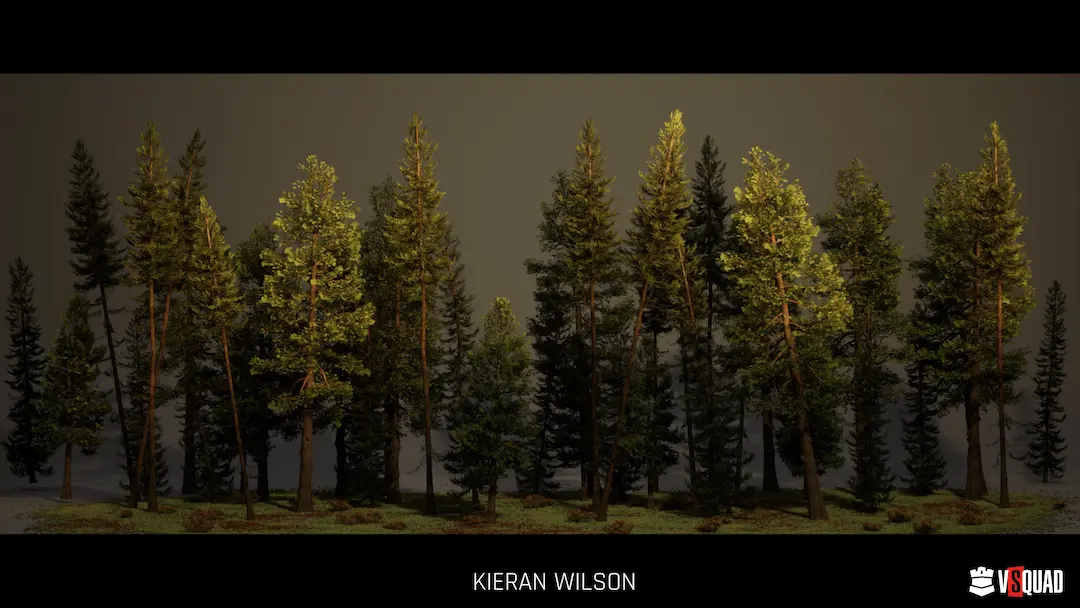
Lighting, silhouettes, background structures, markings, and world composition all quietly help players understand where to go and what matters.
Q: How do AAA teams think about landmarks and player orientation inside a large world?
A: We call it visual language.
It is everywhere, and most of the time players do not even realize it.
They are being led by subtle lighting cues, markings, silhouettes of mountains, or large structures in the background.
And if all that does not work, there is always a mini-map or an arrow in the UI telling you which way to go to your next goal.
Q: Lighting is often invisible to people until it is wrong. How much production time can lighting take on a game world of that scale?
A: In my last few studios, I have always had a dedicated team for lighting production.
They are there from the beginning investigating new techniques for lighting, clouds, and other visual systems.
This is split into environment lighting and character lighting.
Lighting in games is very complex, and in huge productions you need to check every area to make sure there are no light leaks or glitches.
Some parts of lighting are automated, but it is never fully done until the environments and animations are done.
Even things like breakables that cast a shadow and are then broken up need scripting to tell them not to cast a shadow once they no longer exist.
I will also say that when the lighting goes in, the game absolutely shines.
When Great Art Gets Cut
Game development is iterative by nature. That means even strong art can be changed, reduced, or removed if the game needs something different.
For managers and leads, part of the job is not only solving production problems, but also helping artists through the emotional reality of seeing their work cut.
Q: How do you make decisions when the art is strong, but the game needs changes because of design, performance, schedule, or production reality?
A: Welcome to game development, where your dreams can get crushed.
Just kidding, but it happens far more than anyone can see from the outside.
To make a great game, you need to iterate. And to iterate means you will sometimes stomp on finished art that looks amazing.
Things can get cut if the schedule gets pushed out or the budget gets chopped.
As a manager, a lot of my job was sometimes working with people who had lost their work and understanding the emotional toll that takes.
I have had that happen to me many times. While it sucks, it did lead to a better game.
Making Small Worlds Feel More Expensive
Smaller teams cannot copy AAA budgets, but they can learn from AAA thinking.
Mike’s advice is to be clever with reuse, put attention into memorable hero assets, and use motion, composition, and environment systems to make worlds feel richer than their raw asset count.
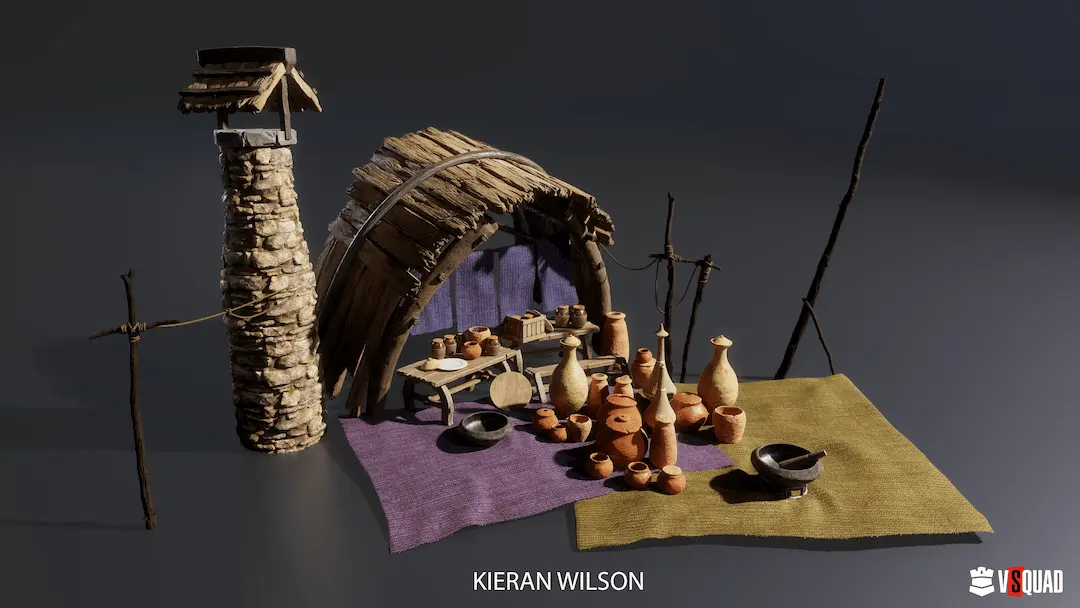
Q: If a small studio wants its world to feel more expensive than its actual budget, what should it prioritize first?
A: I do not think there is one magical solution.
I have seen some games do very well by reusing kit work.
The Ghost of Tsushima did a great job in my opinion. It reused a lot of foliage, but had it all animating with wind: grass, trees, and so on. That helped remove the feeling of repetition and made everything look beautiful.
Some Far Cry and Assassin’s Creed games also do this well.
You do not need to have a huge team. You just need to be clever in how you use your assets.
Put the love into the hero’s assets that people will remember.
The Blueprint of Modern AAA Game Development
Mike Swanson’s answers show that AAA game worlds are not expensive simply because the art is beautiful. They are expensive because every asset sits inside a larger production system.
A rock might be part of a modular kit. A wall might need LODs, breakable states, optimization, and repeated use across multiple areas. A lighting pass might involve environment lighting, character lighting, shadows, animation dependencies, and endless edge cases.
The biggest lesson for smaller teams is not to copy AAA scale. It is to copy AAA thinking where it matters: plan reuse, build modularly, protect readability, guide players through visual language, and spend the most love on the assets players will actually remember.
Great game worlds are not only built by artists. They are built by pipelines, planning, iteration, lighting, production leadership, and the ability to make smart trade-offs when reality changes.
Explore more behind-the-scenes stories in our exclusive interview series. We have many more conversations with industry visionaries coming soon, so be sure to visit us again.
Get in touch
Got a project in mind? We usually reply within a day.