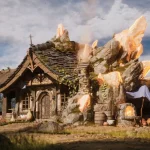



Tempest Rising is a modern RTS inspired by classic strategy games like Command & Conquer. Developing games in this genre presents a unique challenge for artists: units, buildings, and environments must not only look visually appealing but also remain easy to read during large-scale battles.
In this interview, Senior Concept Artist Christian Quinot discusses the visual design of Tempest Rising, faction design, environment concept art, and the techniques used to maintain gameplay readability in an RTS environment.
In this interview, Senior Concept Artist Christian Quinot discusses the visual philosophy behind Tempest Rising, the challenges of creating strong faction identities, and how concept art evolves when it meets the realities of gameplay.
Main topics:
– RTS concept art
– Gameplay readability
– Faction design
– Visual production
– Environment design
– Unreal Engine 5
– Art pipelines
– Outsourcing collaboration
Designing a Modern RTS
Tempest Rising was created as a modern RTS inspired by the strategy games that defined the late 90s and early 2000s. While the project embraces familiar foundations, it also aims to deliver a more contemporary experience.
Q: Could you tell us a bit more about 3D Realms and what the studio is focused on today?
A: The modern version of 3D Realms is based in Aalborg and primarily focuses on publishing and co-developing action-oriented games rather than operating as a large in-house AAA developer.
Since being acquired by Saber Interactive in 2021, the company has leaned heavily into what it calls “Redefining AAA,” focusing on games with strong gameplay identity regardless of budget size.
Currently, there is a strong focus on the RTS space following the release of Tempest Rising.
Q: Could you tell us more about Tempest Rising and what kind of game it is?
A: Tempest Rising is a modern real-time strategy game inspired by classic RTS titles such as Command & Conquer.
The goal was to capture the feeling of classic RTS gameplay while modernizing the experience through Unreal Engine 5 visuals, smoother controls, cinematic presentation, and deeper strategic systems.
The soundtrack also features legendary RTS composer Frank Klepacki, helping reinforce the classic strategy atmosphere.
Balancing Nostalgia and Modern Visuals
One of the biggest challenges behind Tempest Rising was preserving the elements that made classic RTS games memorable while taking advantage of modern production capabilities.
Q: Was it important to keep that old-school RTS spirit?
A: Absolutely.
Preserving the classic RTS spirit was one of the project’s core pillars from the beginning.
The team wanted to capture what made the golden era of RTS games memorable: strong faction identity, strategic base-building, resource control, and fast-paced tactical decision-making.
At the same time, the goal was never to simply recreate the past. The idea was to evolve the formula through modern visuals, smoother controls, improved quality-of-life systems, and more dynamic presentation.
Q: What was the most interesting part of creating the visual style for Tempest Rising?
A: One of the most interesting challenges was finding the balance between classic RTS readability and modern visual fidelity.
Traditional RTS games relied heavily on clear visual language. Players needed to instantly recognize units, structures, faction identities, and battlefield situations from a zoomed-out perspective.
At the same time, Tempest Rising aimed to create a more immersive and cinematic world than those older games could technically achieve.
The alternate-history setting also provided exciting opportunities. The combination of post-war environments, military technology, and mysterious Tempest growth helped create a world that blends military realism with subtle science-fiction elements.
Designing for Readability
For many genres, visual complexity is often seen as a positive. In RTS games, however, clarity is often more important than detail.
Q: RTS games can have a lot happening on screen at once. How did you make sure units and environments stayed easy to read?
A: Readability was treated almost like a gameplay system rather than simply a visual concern.
The main goal was that players should understand the battlefield instantly, even when things become chaotic.
Strong silhouette design played a major role. Each faction was given its own shape language so players could identify units at a glance, even from a high camera angle.
Visual hierarchy was equally important. Units remain visually cleaner than environments, while contrast, animation, lighting, and effects all work together to keep critical information visible.
Ultimately, every visual decision had to support player decision-making.
When Concept Art Meets Gameplay
Concept art often begins with exciting ideas, but not every idea survives contact with real gameplay.
Q: Were there any units, buildings, or environments that changed significantly during development?
A: Yes.
Many units started out much more detailed and visually complex. Over time, they were simplified to improve readability during gameplay.
Buildings also went through significant iteration, particularly regarding scale and footprint. RTS players need to understand spacing, pathing, and building functions quickly, so many structures were adjusted to better support gameplay.
Q: What usually takes the most time when creating concept art for a strategy game?
A: The most time-consuming part is balancing creativity, clarity, and gameplay requirements.
Concepts often go through multiple rounds of silhouette refinement, simplification, and iteration before they function properly at RTS scale.
A large amount of time is also spent collaborating with designers and engineers to ensure concepts work within gameplay and technical constraints.
Q: Was there anything that looked great in concept art but became harder to make work in the actual game?
A: One of the most common challenges was detail density.
Concept art can support a huge amount of visual detail, but once assets are viewed from an RTS camera with dozens of units on screen, that detail often turns into visual noise.
Many assets had to be simplified or adjusted to maintain clear silhouettes and strong gameplay readability.
Building a Cohesive World
Beyond individual assets, one of the biggest achievements of Tempest Rising is how its various visual systems come together into a cohesive experience.
Q: What part of Tempest Rising’s world or visual style are you personally most proud of?
A: One of the strongest aspects is the faction identity.
Each faction has a distinct visual language across architecture, units, materials, colors, and shapes. Maintaining that consistency across dozens of assets while keeping everything recognizable was one of the biggest accomplishments.
The balance between grounded military realism and subtle science-fiction elements also helped give the game its own identity.
Q: Did the project rely mostly on internal art production, or did you also work with outsourcing teams?
A: The project used a combination of internal development and external production support.
Core visual direction, faction identity, major units, environments, and the overall art bible were handled internally.
Outsourcing was then used to help scale production for secondary assets and production-heavy content while following established visual guidelines.
The result was a pipeline where the internal team defined the vision and external partners helped expand production while maintaining consistency.
Conclusion
Christian Quinot’s insights highlight an important reality of RTS development: creating great-looking assets is not enough. Every unit, building, and environment piece must help players quickly understand what is happening on the battlefield and make informed decisions.
Tempest Rising is a strong example of how classic RTS principles can be combined with modern technology and visual standards. Throughout development, the team focused not only on visual quality but also on readability, faction identity, and making battlefield information easy for players to process.
For artists and developers, this serves as a reminder that great RTS art is not just about visuals — it is also about communication. The easier it is for players to read and understand the action on screen, the better the overall gameplay experience becomes.
Explore more behind-the-scenes stories in our exclusive interview series. We have many more conversations with industry visionaries coming soon, so be sure to visit us again.
Get in touch
Got a project in mind? We usually reply within a day.