


Unlike characters or environments, VFX cannot be estimated accurately from an asset list alone.
Before production begins, the most important decision is the technical approach. The same gameplay effect may require completely different production time depending on whether it uses 2D flipbooks, Niagara particles, mesh effects, or a combination of these techniques.
A good estimate starts with the pipeline, not the effect list.

Why VFX Is Difficult to Estimate
A fireball can take 4 hours or 24 hours because the name alone tells us very little about the actual work.
A simple fireball may need only a projectile, trail, and impact. A more complex version might include charging, lighting, distortion, several impact types, and different reactions to enemies or surfaces.
↓ Production Artwork
The visual result can also be misleading. A simple-looking effect may require several technical layers and a lot of testing in the engine. At the same time, a detailed effect may be faster if the team can reuse existing materials or particle systems.
VFX also needs to be clear during gameplay. Players should understand where the attack is going, how large it is, and when it becomes dangerous. This often requires a few rounds of testing and adjustment.
That is why the estimate depends on the pipeline and gameplay requirements, not just on how complex the effect looks.
Choose the Workflow First
Explain the three common approaches.
2D Flipbook VFX
↓ Example of 2D Flipbook VFX

- Fastest production — Effects are created as frame-by-frame animations and placed on simple planes or sprites.
- Stylized look — Well suited for hand-painted effects, clear shapes, and exaggerated motion.
- Lower production cost — Usually requires less technical setup and engine work than full 3D effects.
3D Niagara VFX
↓ Illustrative Example of Niagara Projectile VFX

- Richer visuals — Supports particles, meshes, shaders, lighting, and dynamic movement.
- More flexibility — Effects can react to characters, surfaces, gameplay events, and environmental conditions.
- Higher production cost — Requires more technical setup, engine integration, testing, and optimization.
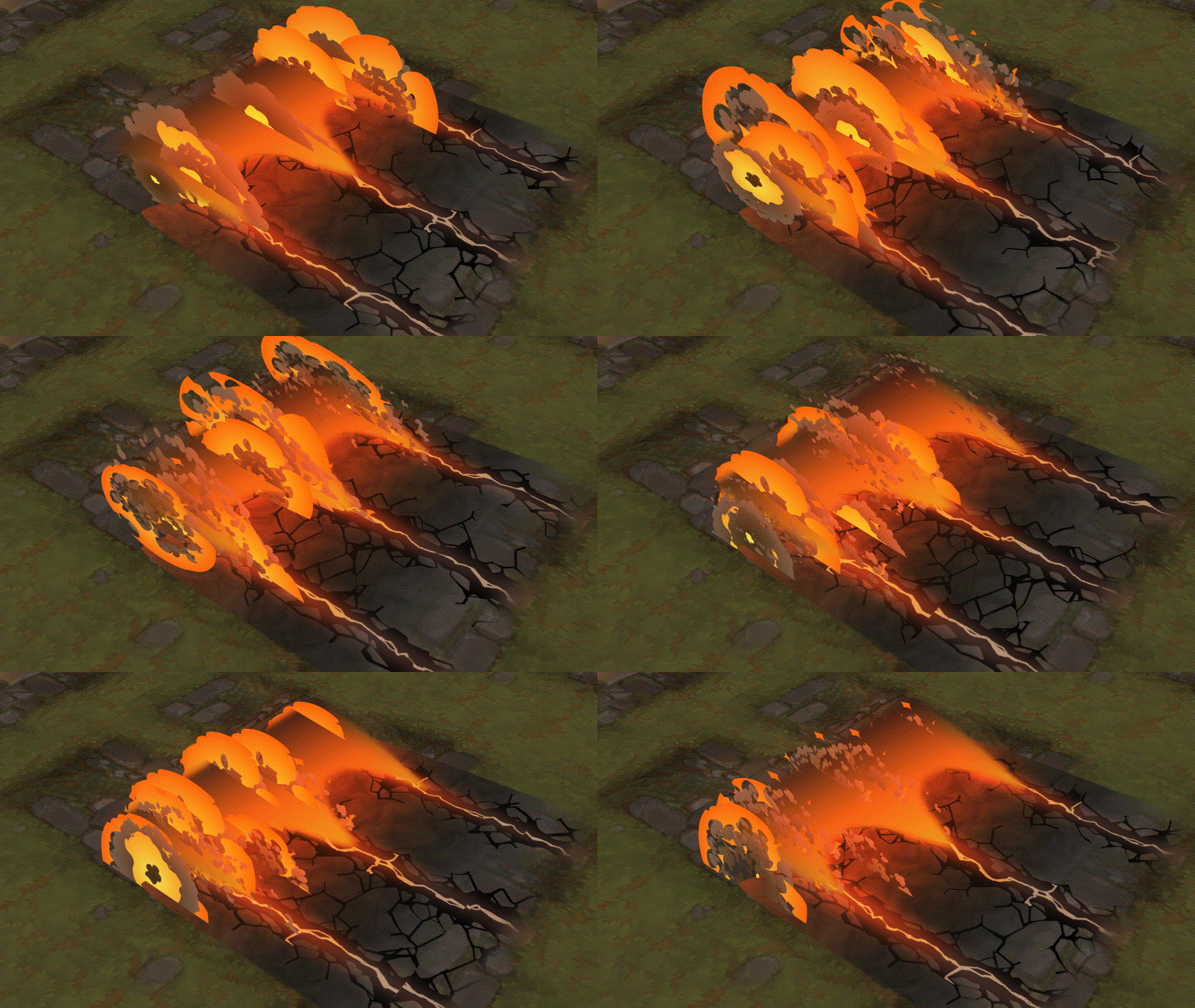
Hybrid Workflow
↓ Example of a Stylized Hybrid VFX Effect
Estimate by Complexity Tiers
Instead of estimating every effect individually, group VFX by production complexity. Each tier should reflect the number of visual layers, technical setup, gameplay logic, engine integration, and expected iteration time.
Tier 1 — Simple
Small effects with limited duration and straightforward behavior. They usually require few visual layers and minimal gameplay logic.
↓ Example of Tier 1 — Simple VFX

- Small impacts
- Status effects
- Hit sparks
- Simple trails
- Minor environmental effects
Tier 2 — Standard
Core gameplay effects that need stronger visual readability, several production layers, and more testing in the engine.
↓ Example of Tier 2 — Simple VFX

- Projectiles
- Weapon abilities
- AoE indicators
- Elemental attacks
- Medium gameplay effects
- Standard character abilities
Tier 3 — Complex
Large or important effects built from multiple stages and technical components. They often require custom shaders, gameplay timing, several versions, and additional optimization.
↓ Example of Tier 3 — Simple VFX

- Boss abilities
- Ultimate skills
- Large elemental attacks
- Multi-stage gameplay effects
- High-readability hero abilities
- Effects with multiple gameplay states
Gameplay Readability Comes First
A beautiful effect is useless if players cannot understand what is happening.
Players should immediately see the affected area, timing, danger level, and whether the effect belongs to an ally or enemy. This often requires testing and adjustments to color, size, and intensity.
The estimate should include this iteration, not only the first visual version.
Questions Before Estimation
- Will the project primarily use 2D Flipbooks, 3D Niagara, or a hybrid workflow?
- Will VFX concepts or visual references be provided?
- Should VFX be designed from gameplay descriptions?
- Does the estimate include Unreal Engine integration and polishing?
- Approximately how many VFX belong to each production tier?

Conclusion
The best VFX estimates do not begin with simply counting effects.
They begin by defining the technical pipeline, grouping effects by production complexity, and understanding how each effect supports gameplay. The estimate should also account for engine integration, readability testing, iteration, and optimization.
This approach provides a more realistic production plan and reduces the risk of unexpected work later.
Get in touch
Got a project in mind? We usually reply within a day.