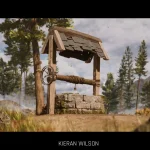



A location should never be estimated as a single asset.
Professional environment production starts by breaking each location into reusable systems: modular architecture, prop libraries, landmarks, terrain materials, and gameplay objects.
This approach produces more accurate estimates while reducing production time through asset reuse.
Why Environment Estimates Often Fail
Environment estimates often fail when an entire level is treated as a single production task. A location may look like one finished scene, but it usually includes modular architecture, terrain materials, vegetation, props, landmarks, lighting, and gameplay-related objects.
Another common issue is ignoring asset reuse. Without a clear Modular Asset Library, teams may estimate similar buildings, rocks, vegetation, or architectural elements as separate assets instead of planning how they can be reused across multiple locations.

Gameplay objects and decorative props should also be estimated separately. Interactive objects require additional states, technical setup, animation, or engine integration, while decorative assets mainly support visual detail.
Hero landmarks need their own scope as well. A unique temple, gate, or boss arena requires more production time than a reusable modular piece. Separating these asset types makes the Game Environment Estimate more accurate.

Plan the Location Before Building It
Before estimating production, define the location layout, gameplay flow, visual theme, required landmarks, and opportunities for asset reuse.
If the level layout already exists, the team can estimate the environment based on actual routes, spaces, and gameplay requirements. This makes it easier to understand which assets are reusable and which areas need unique content.
If the layout has not been created yet, Level Art Planning should be estimated as a separate production stage.

Build Asset Libraries First
Instead of creating every object for a specific location, start with a Modular Asset Library. It can include modular buildings, trees, rocks, ground materials, vegetation, architectural pieces, and props.

These assets can be combined in different ways across multiple locations. A well-planned library reduces duplicate work, speeds up environment production, and helps keep the game world visually consistent.
The library should be defined early in the Environment Art Pipeline. This makes it easier to estimate which assets need to be created once, how often they can be reused, and where unique assets are still required.
Separate Hero Assets from Modular Assets

Modular assets work differently. They should be flexible enough to appear across several buildings or locations in different combinations.
Separating hero and modular assets early gives the team a clearer idea of where the production budget will actually go.
Gameplay Props vs Decorative Props
Gameplay props and decorative props may look similar, but they require different production effort. Separating them early makes the scope easier to estimate.
Gameplay Props
- Doors
- Chests
- Crates
- Interactive objects
- Switches
- Quest objects
Gameplay props may requiecorative Prre multiple states, animation, collision setup, VFX, or engine integration. Their behavior should be included in the estimate.

Decorative Props
- Barrels
- Furniture
- Plants
- Small clutter
- Background assets
Decorative props are mainly used to fill the environment and support its visual style. They are usually simpler to produce and easier to reuse across locations.
This separation makes Level Art Planning more predictable and prevents interactive objects from being estimated as standard environment assets.
Questions Before Estimation
Before preparing a Game Environment Estimate, clarify the actual scope of the world and the current production stage.
- Do level layouts already exist, or do they still need to be designed?
- How many locations are planned for the full game and the current production stage?
- How many biomes are required, and how different are they visually?
- Which assets can be reused from existing libraries?
- Which assets must be created from scratch?
- How many unique hero landmarks are required?
- Which props need interaction, animation, or technical setup?
- Which props are purely decorative?
- Is a Modular Environment workflow already planned?
These answers help separate layout work, reusable asset production, unique content, and engine integration before the estimate is finalized.
Production Benefits

A modular approach allows the team to:
- Reduce production costs
- Reuse assets across multiple locations
- Build and iterate on environments faster
- Keep the game world visually consistent
- Add new locations and content more efficiently later
The main benefit is not simply creating fewer assets. It is building a flexible system that gives the level art team enough variety without unnecessarily increasing the scope of the Environment Art Pipeline.

Conclusion
A reliable Game Environment Estimate starts with breaking each location into clear production groups: modular assets, hero landmarks, gameplay props, and decorative content.
Once these groups are mapped, the team can see what needs to be created from scratch, what can be reused, and which assets require additional technical work.
This makes the Environment Art Pipeline easier to plan and gives the project better control over production time and budget.
Get in touch
Got a project in mind? We usually reply within a day.