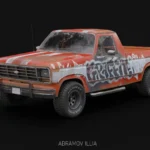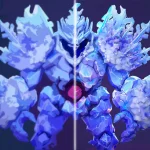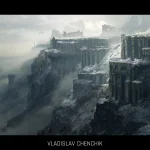



There is a reason so many 3D artists start by modeling a weapon.
Weapons, vehicles, and machines are exciting to build. They combine art, engineering, design, and the satisfaction of creating something powerful and believable.
But creating one impressive weapon is very different from building a long career in hard-surface art. Behind the polished renders are reference research, file organization, revisions, baking, texturing, engine setup, LODs, and sometimes months of work that will never become a portfolio piece.
↓ Artwork by Sergejs Karpovs
Sergejs Karpovs has spent more than fifteen years in game art, moving from graphic design and UI into vehicle and hard-surface production. His career has taken him through outsourcing Elite3D, Cloud Imperium Games, PlayerUnknown Productions, and Raven Software.
In this interview, Sergejs shares what artists should learn, what the job is really like, and how to turn an interest in weapons and machines into a serious profession.
Main Topics:
- Hard-Surface Art Career
- Weapons and Vehicle Modeling
- AAA Game Art Production
- Technical Skills and Asset Optimization
- Portfolio Advice for Junior Artists
Interview
With Sergejs Karpovs, Senior Hard-Surface Artist at Raven Software

Q: Many artists model a weapon at least once. How did you turn that interest into a real career?
Weapons are among the first things many 3D artists want to create, but few go on to build careers working on major franchises like Call of Duty or ambitious projects such as Star Citizen and Squadron 42.
How did you enter hard-surface art, and when did it become more than just an interesting type of modeling for you?
↓ Artwork by Sergejs Karpovs

I always wanted to work on cinematic, narrative-driven games, creating hard-surface assets. When I first started learning 3D, I asked myself what is the best path to achieve that goal. For me, it meant focusing on weapons, vehicles, and all kinds of cool sci-fi props.
In the beginning, I focused on vehicles because they have a more complex structure, and that also opened the opportunity for me to work as a vehicle artist at Elite3D. At the same time, I really wanted to make weapons too. I realized that getting the opportunity to work on story-driven, non-racing projects requires a combination of practical skills like weapon and vehicle creation, and strong technical knowledge.
In many cases, this role is a hybrid position, such as a vehicle/weapon artist, or simply what people call a hard-surface artist. Sometimes there isn’t enough work to focus only on vehicles or weapons throughout an entire project.
Working on weapons is especially rewarding because it allows you to explore multiple disciplines: hard-surface design, rigging, animation, VFX, realistic texturing, and sometimes even game design logic and mechanics. All these are not always possible to handle alone when working on vehicles, as they tend to be far more complex and time-consuming, especially when producing game-ready assets.
↓ Artwork by Sergejs Karpovs

I still pursue this creative endeavor because it’s fun, and because it’s amazing to create narrative experiences that people can enjoy, remember, and carry in their hearts.
I feel very lucky to be able to make a living creating hard-surface art, and I’m truly grateful for all the opportunities people have given me.
I believe that if you are passionate about something, others will see and opportunities will come one day. But you always need to be ready when they do – that’s why you should keep learning and practicing all the time.
Q: What should someone really be prepared for before choosing hard-surface art as a career?
The attractive part is creating weapons, vehicles, and machines. But the job can also involve strict naming rules, direct feedback, repeated revisions, baking normal maps, fixing technical problems, creating LODs, setting up shaders, and doing the same type of task for months.
Which parts of the profession surprises beginners most? What should they start taking seriously from their first day?
It can be very challenging – most of the time, it is. People need to be ready to do their homework, because the job is not always about creating art. In many cases, it’s more about problem solving. At the same time, the expectation is always that you can deliver world-class artwork when task like that comes up.
↓ Artwork by Sergejs Karpovs

To meet that expectation, you need to keep practicing. Whether it’s art or technical skills outside of work, one should always invest in their craft, and they will achieve stronger results and make work stand out that way. A strong technical foundation is essential for great artwork, and cutting corners will almost always come back to hurt you.
Hard-surface assets take time to make. If your technical foundation is weak – whether it’s unoptimized UVs, poor topology, inefficient polycount, or not gathering enough references before starting modeling. Your work will start falling apart closer to the final delivery, even if the high poly initially looked solid.
That’s why I highly recommend starting with optimized UVs. Good UVs help you achieve better texture details, improved performance, and higher fidelity on the final low-poly asset. A well-optimized low poly allows you to push more detail where it matters and helps your work to stand out when the game ships.
If you ignore the foundation, your asset can be downgraded to LOD5 with 1k textures or completely removed during the optimization stage, when there’s no time left to rework it. Technical teams will make tough decisions to meet performance target, but don’t give them a reason to cut your work from the game. Save their time and inspire them with how well your asset is optimized.
LODs should be treated as part of the artwork, especially LOD1. It’s its own art form – preserving as much detail as possible while reducing polycount by 30–50%. Without proper LODs, an asset cannot be considered finished and is another reason it might be removed from the game.
↓ Artwork by Sergejs Karpovs

Be prepared to rebuild your assets from scratch if needed. It’s a tough reality, but production has its own demands. Baking normal maps is also its own discipline, and studying resources like the Polycount wiki and others will help you achieve near-zero seam quality, which is expected in AAA production. If you can’t achieve that, it means there’s still more to learn and practice.
AAA assets can be expensive, and expectations are always high. Sometimes your work won’t involve modeling at all, so setting up materials and shaders is just as important. Without proper shader setup, your asset won’t look good in-engine. Photorealistic textures alone are not enough. Materials like translucent or refractive transparent plastics, iridescent surfaces, and anisotropic specular metals require correct shader work to look believable in-game.
All aspects of creating optimized hard-surface art can be enjoyable if you take them seriously and find satisfaction in the process. Beyond that, practicing traditional art skills, like painting and color theory, will elevate your work even further.
It’s a common misconception that photorealistic hard-surface art should simply replicate real life. That’s not entirely true. As artists we interpret and enhance reality. Adjusting shapes and forms can make assets more expressive, readable, and impactful. Even carefully crafted photogrammetry can look better than raw real-world capture when guided by artistic intent.
Every color, shape, and form resonates with us as human beings. Even something simple like dust can carry subtle color variation, whether blue, red, yellow, or green. All of this can still be realistic, but the choice of colors is ultimately up to you as an artist.
As an example, there’s nothing more beautiful than oxidized bronze or brass. It’s a perfect example of natural color harmony in the real world.
Q: Hard-surface art is not only weapons and vehicles. What does the job actually look like?
Many artists enter the field because they want to create weapons, vehicles, and machines. But real production can also mean modeling lamps, stools, trash bins, piles of garbage, or small pieces of a level.
How important is it to approach these less glamorous tasks with the same care as a hero asset? Should artists learn to create a wide range of hard-surface assets instead of focusing only on weapons?
↓ Artwork by Sergejs Karpovs

I believe every asset should be treated as a hero asset. Maintain the same professional attitude no matter what you are working on, whether it’s a simple box or a high-speed space fighter. Challenge yourself!
Smaller assets give you the opportunity to practice skills you don’t always have time to explore on high-demand production assets. Those larger assets come with tight deadlines and very high expectations for quality. If you start feeling bored working on smaller props, set yourself a goal: “I’m working on this trash bin, so how can I make it more interesting?” Improve the design, make textures look hyper-real, add rigging and animation, or even create your own VFX.
By doing this, you develop new skills in a low-pressure environment where no one is judging you. At the same time, the asset becomes much more interesting, and everything you learn can later be applied to more complex work. This approach will help you grow and become a stronger artist.
Personally, I always try to improve the game itself by adding a sense of story to every asset I create, making the experience more engaging for players. If I’m given the opportunity to make something as simple as a lamp, I’ll do my best to make one of the most memorable lamps in a game.
↓ Artwork by Sergejs Karpovs

I believe it’s important to specialize deeply in something, while also having a broad understanding of the entire pipeline. That balance helps you stay competitive and valuable on a project. Sometimes my role isn’t focused on modeling or production at all, so I might be doing technical artwork instead. It requires a significant investment of time, but it’s very rewarding, as it allows me to take an asset from concept to final in-game implementation.
If your goal is to focus only on weapons or vehicles, that’s completely valid. However, at some point in your career, you may realize that working across a wider range of hard-surface assets can expand your artistic potential. If you are truly committed to specializing in weapons or vehicles, don’t compromise – go all in.
Q: How important is it to collect and study your own references?
Some artists visit ranges or use a wide range of visual references for weapons. Others go outside with a camera and photograph machinery, street objects, damaged surfaces, and pieces of environments for future models and textures.
How much can an artist learn from online references alone? Does seeing and handling real objects change the quality of the work?
↓ Artwork by Sergejs Karpovs

Understanding how real-world objects are made always gives artists an advantage. Before I started working in 3D, I worked as an electrician, and that experience gave me a different perspective on how I approach hard-surface art. Every machine or technical object should make sense. People should understand how it works, how it’s maintained, and how it’s built. If you can translate these fundamentals into your artwork, even a quick glance at your asset will make it feel believable because everything follows a logical structure.
Observing real-world objects is critical, especially for hard-surface artists. There is a clear difference between artists who understand how things work and those who don’t. To create believable hard-surface assets, you need to study real-world references and reflect their logic in your work.
For example, when creating a weapon, you should understand how the bolt carrier operates and how far it travels to chamber a round from the magazine. The same principle applies to vehicles and other mechanical assets. If your model doesn’t look functional or believable, the immersion breaks.
To achieve realism, you need to do your own research and constantly refer to real-world examples. This approach will significantly improve the quality of your work.
Q: How can a hard-surface artist continue growing after learning the basic production skills?
Once an artist can model, bake, texture, optimize, and prepare assets for an engine, what helps them move further in their career?
How useful are drawing and design skills for someone who wants to take on more creative responsibility or eventually become a lead or art director?
↓ Artwork by Sergejs Karpovs

Art fundamentals – such as drawing, design, and color theory – are very critical from day one. They help you create more believable assets and make them more visually appealing. Unfortunately, I don’t always have enough time to draw or paint anymore, but I actively try to keep practicing whenever I can. These skills train your eye to recognize beauty in color, composition, proportion and shapes language which can be directly translated into hard-surface art. Many iconic principles – like the 70/30 proportion rule, color harmony, details balance come from traditional art and can significantly improve even the most realistic assets.
Being an art lead or art director is very different from being an artist and requires a completely different skill set. It’s less about creating art and more about working with people – supporting them, guiding them, and taking responsibility as a manager. If your goal is to become an art lead, you need to shift your focus toward communication, psychology, conflict resolution, management, and technical understanding.
↓ Artwork by Sergejs Karpovs

Art direction, on the other hand, is about vision. It builds on the experience of a lead artist but requires a stronger focus on ideas, concept development, and the overall creative direction. That’s why, in most cases, art directors come from lead artist roles.
In both roles, communication is the most important skill. Different people process information in different ways. Some prefer a structured, tactical, and polite approach, while others respond better to direct, dynamic, and bold communication. You also need to be prepared to navigate complex relationships and long-term dynamics within teams.
For Small Game Studios
Q: How can a team create accurate references for a weapon or vehicle when it only has photos?
Photos may show different angles, use different lenses, and provide no exact dimensions or technical drawings.
How should a team turn them into a clear reference pack that a hard-surface artist can actually follow? What needs to be approved before modeling begins so that proportions and design decisions do not keep changing later?
A strong hard-surface artist should have a solid sense of proportion, a good eye for design, and the ability to feel form in 3D space. Even from a single reference image, or something as simple as a sketch on a napkin – they should be able to create a compelling result. Reaching that level is an important goal for every hard-surface artist. Practicing figure drawing, still life, and hard-surface concepting in 3D software will help you get there.
↓ Artwork by Sergejs Karpovs

If your goal is to model something that exists in the real world, I highly recommend searching for blueprints and accurate scale references online. Watch as many videos as possible of the specific object you are trying to recreate. It also helps to study similar objects – for example, we all have an intuitive understanding of how the scale of a toaster relates to a kitchen blender.
And of course, visit museums – it’s a must for every artist.
For Young Artists
Q: What do studios really look for in a junior hard-surface artist’s portfolio and résumé?
Which details show that a candidate understands real production, not just how to create one attractive render?
Are there common mistakes, missing skills, or warning signs that young artists often do not realize employers notice?
When it comes to UVs, very few junior artists truly understand how important proper UV mapping is, along with clean topology and efficient polycount. You should always present a breakdown of your model in your portfolio, especially if you want to become a hard-surface artist in the game industry. It’s also a great self-check for aspiring artists.
↓ Artwork by Sergejs Karpovs

Clean, evenly distributed, and efficiently packed UVs with straight border edges to prevent anti-aliasing issues during normal map baking can say a lot about an artist’s skill level. As an artist, your work should speak for itself more than your resume. At the end of the day, people need to know that you can deliver.
For all game artists, having a basic understanding of a game engine – such as Unreal Engine, Unity, or Godot – and knowing how to integrate your assets is a must-have skill.
Ultimately, all these skills can be learned. What matters most is understanding why you want to become a hard-surface artist and how dedicated you are to improving yourself.

Conclusion
Hard-surface art can look like one of the most exciting jobs in game development.
But a long career is not built only on polished weapons and cinematic renders. It also depends on technical discipline, patience, attention to feedback, and the ability to complete work that may never appear in a portfolio.
For artists who genuinely enjoy understanding how objects are built and why they work, that combination of art and engineering can become a powerful career path. Ultimately, it comes down to one question: what is your motivation, and why do you want to dedicate yourself to this profession?
There is also an important distinction between working in a studio and working as a freelance or outsource artist. Each path comes with different expectations, responsibilities, and creative opportunities.
If your primary goal is to focus purely on creating art, outsourcing studios may be a better fit. However, if you want to be deeply involved in building the game itself, or contributing beyond individual assets and helping shape the overall experience, then working in an in-house studio is likely the stronger path.
In the end, success in hard-surface art is not defined by a single impressive piece, but by discipline, consistency, growth, and the ability to deliver meaningful work within a real production environment.
Get in touch
Got a project in mind? We usually reply within a day.